09 Jul
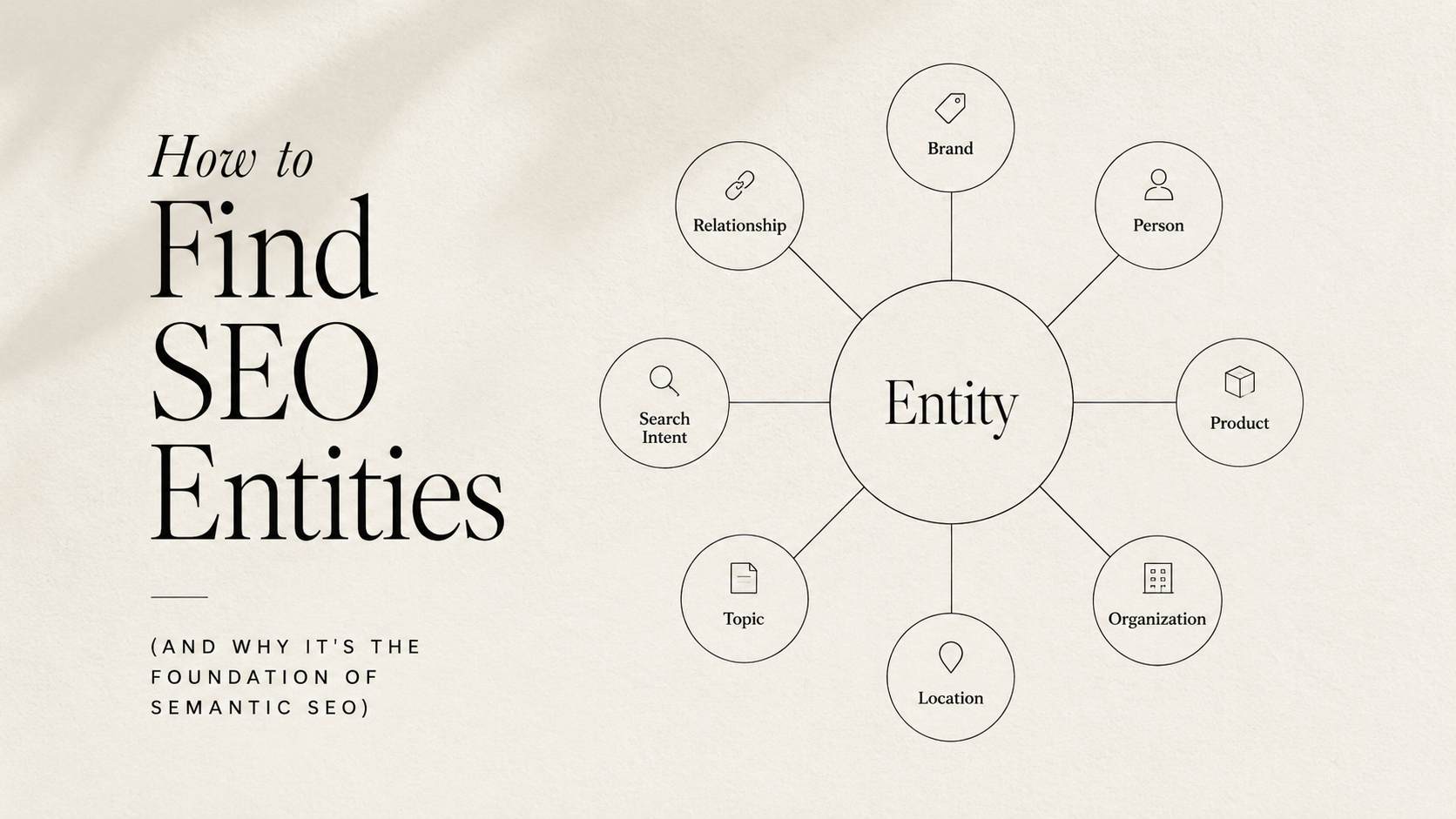
A keyword is a string of text. An entity is a thing – a person, place, brand, or concept Google can uniquely identify, no matter which words describe it. To find SEO entities, pull them from four sources: SERP features, Google’s Knowledge Graph Search API, competitor content run through the Natural Language API’s salience scoring, and Wikidata’s attribute graph. Here’s how to use each one.
What Are SEO Entities? (Entities vs Keywords)
A keyword is how someone types a query. An entity is what Google understands that query to be about. “Apple” the keyword is ambiguous. “Apple Inc.” the entity isn’t – it’s a disambiguated node in a graph, with a Knowledge Graph ID and relationships to entities like Tim Cook and the iPhone.
This matters because modern Google matches meaning, not just strings. Content built around well-defined entities gets pulled into AI Overviews, Featured Snippets, and knowledge panels far more reliably than content that’s merely keyword-dense.
Google’s Knowledge Graph definition
Google launched the Knowledge Graph in 2012 to move beyond string-matching. Per Google’s documentation, the Knowledge Graph has millions of entries that describe real-world entities like people, places, and things, and these entities form the nodes of the graph. Each is a discrete “thing,” connected to other things, not just a word on a page.
Named vs. unnamed entities
Not every entity is a proper noun. Google’s Natural Language API docs state that entities broadly fall into two categories: proper nouns that map to unique entities, or common nouns, also called “nominals”. “Sushi” and “service” are both valid entities in a restaurant review. Entity SEO isn’t “add more proper nouns” it’s building a clear, well-supported topical structure.
Google SEO Entities – What Google’s Own Documentation and Patents Say
If you want to know how Google finds and scores entities, skip the SEO blogs and go to the primary sources.
Knowledge Graph Search API + Natural Language API
The Knowledge Graph Search API lets you query Google’s entity database directly, useful for getting a ranked list of the most notable entities matching certain criteria, predictively completing entities in a search box, and annotating content using Knowledge Graph entities. Note: it returns individual matching entities rather than graphs of interconnected entities – for relationships, you need Wikidata.
The Cloud Natural Language API scores each entity in a text by importance. Per Google, the salience score, in the 0 to 1.0 range, indicates an entity’s importance or centrality to the document – scores closer to 0 are less salient, closer to 1.0 are highly salient. It’s the most underused tool in entity SEO: it tells you what a machine thinks your page is actually about.
Patent US 10,691,702 – ranked entity lists
Google’s patent US 10,691,702, “Generating ranked lists of entities,” describes a system that determines when a query is associated with an entity list, identifies the relevant category of entities, and presents them in a list format separate from but alongside standard web results. That’s the mechanics behind “best running shoes” carousels. Google isn’t only ranking pages it’s separately assembling ranked lists of things. If your brand isn’t a clean, recognizable entity, it can’t get pulled in.
Entity salience research (Dunietz & Gillick)
The academic foundation here is a 2014 paper by Google researchers Jesse Dunietz and Daniel Gillick. Their core contribution: they introduced the entity salience task – assigning a relevance score to each entity in a document – with a labeled corpus generated automatically from documents and their abstracts. An entity mentioned once in passing isn’t the same as one the whole piece revolves around, and machines can now tell the difference.
They also proposed an “entity graph.” As one analysis of the paper notes, it’s a computation based on the same logic as PageRank, using connectedness between entities rather than links between pages, originally drawing on the now-retired Freebase database – a function that effectively lives inside the Knowledge Graph today.
How to Find SEO Entities – Step-by-Step Framework
Mine SERP features (Autocomplete, People Also Ask, Related Searches)
Type your seed topic into Google and check autocomplete suggestions, every expanded People Also Ask box, and related searches at the bottom. This won’t give you a scored list, but it’s a fast first-pass shortlist of what Google’s query-understanding layer already links to your topic.
Extract entities from AI Overviews via Natural Language API
A tactic most guides skip: run the text of an AI Overview or top-ranking answer through the Natural Language API’s analyzeEntities endpoint. In Google’s own sample response, a passage about a presidential visit returned entities with clearly different scores – the person entity scored 0.79 while the location scored roughly 0.09 – showing exactly what the passage was really “about.” Do this across three or four AI Overview snippets in your niche for a data-backed entity list.
Query the Knowledge Graph Search API directly
The blunt, definitive check: query the API with your brand or product name. As one guide puts it, one of two things happens – Google returns a structured entity result, meaning you’re in the Knowledge Graph, or it returns nothing, meaning you’re not. An empty result usually means insufficient external corroboration: think Wikidata entries and third-party citations.
Analyze Top 10 competitor salience scores
Run the top 10 ranking pages through the Natural Language API and log the top entities by salience for each:
|
Competitor |
Top Entity (Salience) | Entities You’re Missing |
|
Page A |
Espresso machine (0.61) | — |
|
Page B |
Water temperature (0.19, 2nd) |
Water temperature |
| Page C | Extraction (0.66) | Extraction, portafilter |
|
Your page |
Espresso machine (0.54) |
Extraction, water temp, portafilter |
Any entity with meaningful salience across multiple competitors but missing from your page is a gap worth closing.
How to Find Related Entities for SEO
Wikipedia/Wikidata attribute mining
Pull up the Wikidata entry for your core entity and check its “instance of,” “subclass of,” and “part of” properties – these are the same relationships the Knowledge Graph draws on. Every linked term in a Wikipedia infobox is a candidate related entity.
“People also search for” carousels
These carousels on knowledge panels directly show which entities Google considers closely related to the one you searched – often faster to scan than browsing Wikidata manually.
Same As, about, mentions Schema relationships
Encode relationships in schema.org markup: sameAs links to your canonical profile (Wikipedia, Wikidata, LinkedIn), about declaring your page’s primary entity, and mentions flags secondary entities. This doesn’t manufacture recognition, but it removes ambiguity for a crawler already inclined to recognize you.
How to Find Entities for SEO Optimization – Turning Research Into Content
Placing entities for maximum salience (position, frequency, context)
Salience isn’t just mention count – it’s where and how. Three things matter most: position (entities in the title and opening sentence score higher), frequency (repeated mentions throughout, not just the intro), and context (headings and proximity to other high-salience entities carry more weight). Practically: your primary entity belongs in your H1, opening sentence, at least one H2, and conclusion.
Avoiding entity stuffing (E-E-A-T risk)
Cramming in entity mentions to chase salience reads like the old keyword stuffing – and tanks E-E-A-T because the writing stops sounding like it came from someone who knows the topic. As one breakdown of this research puts it, relying too heavily on mention count is the salience factor most likely to reduce writing quality, and tying focus entities too closely to keywords risks stuffing and devaluing content. Write for the human first; structure for the machine second.
Entity Optimization Checklist
- [ ] Identify your page’s single primary entity – one, not five
- [ ] Confirm the entity’s Knowledge Graph status via the Search API
- [ ] Mine autocomplete, PAA, and related searches for supporting entities
- [ ] Run top 10 competitor pages through the Natural Language API for benchmarking
- [ ] Pull related entities from Wikidata properties and “people also search for”
- [ ] Place the primary entity in the title, intro, one H2, and conclusion
- [ ] Add sameAs, about, and mentions schema
- [ ] Re-check your draft’s salience before publishing
- [ ] Cut any mention that doesn’t serve the reader, regardless of score
FAQs
How to find SEO entities?
Combine SERP features (autocomplete, PAA, related searches) for a quick shortlist, the Knowledge Graph Search API to confirm what Google recognizes, the Natural Language API to score entities by salience in top-ranking content, and Wikidata for relationships.
How to find entities for SEO optimization?
Run top-ranking pages through the Natural Language API to see which entities score highest for salience, compare that list against your draft, and place your primary entity in the title, intro, and at least one subheading.
How to find related entities for SEO?
Check the Wikidata entry for your core entity’s linked properties, review the “People also search for” carousel, and look for entities that repeatedly co-occur with your topic across top-10 competitor pages.
What are Google SEO entities?
The discrete “things” – people, places, organizations, products, concepts – that Google’s Knowledge Graph has uniquely identified. Unlike keywords, entities are disambiguated: Google knows exactly which “Apple” you mean.
What is entity optimization? Structuring content so Google’s algorithms can clearly identify your page’s primary subject and supporting related concepts, through strategic placement, schema markup, and cross-web signals like Wikidata entries.
Key Takeaways
Entities are things, not strings – and Google has spent over a decade building infrastructure (the Knowledge Graph, the Natural Language API, patented ranked-entity-list systems) to identify and score them. Query the APIs directly, mine the SERP for what Google already associates with your topic, and benchmark your salience against what’s currently ranking. Write for a human audience first, and let structure not entity density do the optimization work. Start by running your own top page through the Natural Language API today; the gap between what you think it’s about and what Google thinks it’s about is usually the fastest fix on your list.
Artzen is a performance-driven agency specializing in ecommerce SEO services in India. Backed by years of industry experience and a team of certified, highly skilled SEO specialists, we implement strategies with precision and measurable growth. We prioritize our clients at every stage, delivering results that exceed customer expectations.