04 Jun
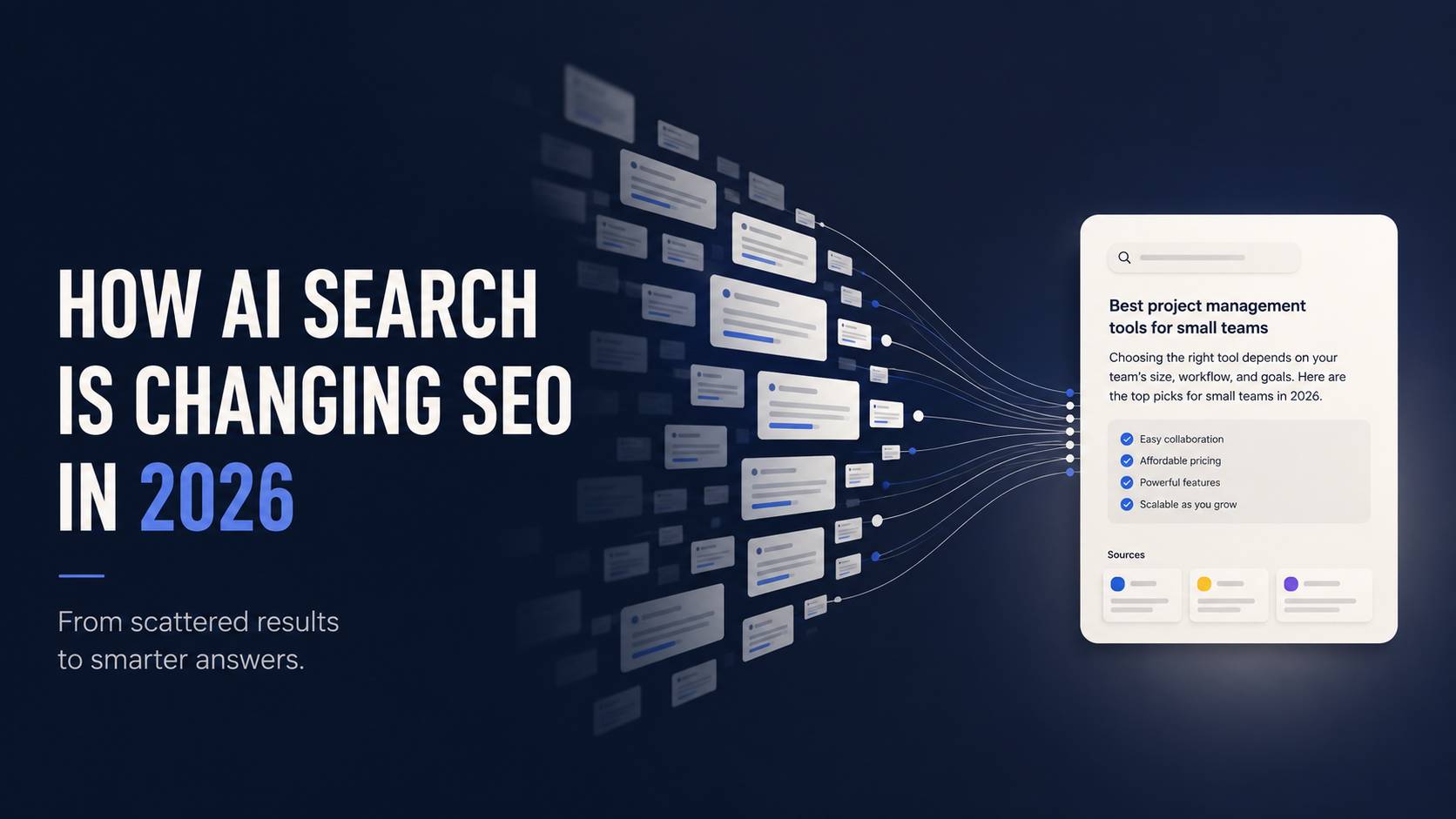
The Future of Search Has Arrived
The SEO landscape is experiencing its most significant transformation since the introduction of Google’s algorithm updates. As artificial intelligence becomes deeply integrated into search engines, businesses, marketers, and SEO professionals must adapt to a new reality where traditional ranking factors are no longer the only determinants of visibility.
The rise of AI-powered search experiences, including AI Overviews, conversational search interfaces, and generative search engines, is fundamentally changing how users discover information online. In 2026, search is becoming less about keywords and more about context, intent, authority, and user experience.
Understanding the latest AI SEO trends 2026 is essential for businesses that want to maintain organic visibility, attract qualified traffic, and stay competitive in an increasingly AI-driven digital ecosystem.
The Evolution from Traditional Search to AI Search
For decades, search engines primarily relied on keywords, backlinks, and technical optimization to determine rankings. While these factors still matter, AI has introduced a new layer of intelligence that interprets user intent with unprecedented accuracy.
Modern AI search systems can:
- Understand natural language queries
- Analyze contextual meaning
- Generate direct answers
- Summarize multiple sources
- Personalize search results
- Predict user intent
Instead of presenting users with a list of links, AI-powered search often delivers complete answers directly within the search interface.
This shift means websites must optimize not only for rankings but also for AI visibility.
Why AI Search Is Reshaping SEO
The biggest change in SEO is that search engines are becoming answer engines.
Users increasingly ask conversational questions such as:
- “What is the best CRM for small businesses?”
- “How can I improve website conversions?”
- “Which solar panel brand offers the highest efficiency?”
AI systems analyze numerous sources and generate summarized responses.
As a result:
- Organic click-through rates are changing
- Informational searches may receive fewer clicks
- Brand authority is becoming more important
- Content quality matters more than ever
Businesses that establish themselves as trusted sources are more likely to be cited within AI-generated responses.
AI SEO Trends 2026: What Marketers Need to Know
1. AI Overviews Are Dominating Search Results
Search engines increasingly provide AI-generated summaries at the top of results pages.
These AI Overviews often answer user questions immediately, reducing the need to visit multiple websites.
To improve visibility within AI summaries:
- Create authoritative content
- Use clear headings and structure
- Answer questions directly
- Include supporting data and statistics
- Demonstrate expertise
Content that provides comprehensive answers is more likely to be referenced by AI systems.
2. Entity-Based SEO Is Replacing Keyword Obsession
One of the most important AI SEO trends 2026 is the growing importance of entities.
Entities are people, brands, places, products, concepts, and organizations that search engines recognize and understand.
Instead of focusing solely on exact-match keywords, SEO strategies must emphasize:
- Brand recognition
- Topic authority
- Knowledge graph associations
- Semantic relevance
For example, a company consistently publishing expert content on cybersecurity will gradually become recognized as an authority entity within that topic.
This improves visibility across AI-generated search experiences.
3. E-E-A-T Is More Important Than Ever
Experience, Expertise, Authoritativeness, and Trustworthiness (E-E-A-T) have become central signals in AI search systems.
AI models actively evaluate content quality indicators such as:
- Author credentials
- Real-world experience
- Expert opinions
- Citations and references
- Brand reputation
- Content accuracy
Organizations investing in expert-led content are seeing stronger performance in AI-driven search environments.
Businesses should prominently display:
- Author bios
- Industry certifications
- Case studies
- Customer testimonials
- Research-backed insights
Trust is becoming a major ranking factor.
4. Conversational Search Optimization Is Growing
Users increasingly interact with search engines using natural language.
Instead of typing:
“best CRM software”
Users now ask:
“What is the best CRM software for a growing service business with less than 20 employees?”
AI search systems understand these longer, conversational queries.
To adapt:
- Create FAQ sections
- Use question-based headings
- Answer specific user concerns
- Cover related subtopics comprehensively
The goal is to match how people naturally ask questions.
The Rise of Zero-Click Search
One challenge associated with AI search is the growth of zero-click searches.
Users often receive complete answers directly within search results.
This trend is forcing marketers to rethink success metrics.
Instead of focusing exclusively on clicks, businesses must monitor:
- Brand visibility
- AI citations
- Share of voice
- Brand mentions
- Assisted conversions
A user may discover a brand through an AI-generated answer and return later through direct navigation or branded search.
This makes attribution more complex but also creates new opportunities for brand exposure.
Content Quality Is Becoming the Ultimate Competitive Advantage
AI search systems reward content that demonstrates genuine value.
Generic content created solely to rank for keywords is becoming less effective.
Successful content in 2026 typically includes:
Original Research
Unique data helps establish authority and provides information AI systems can reference.
Expert Insights
First-hand experience and professional expertise improve trustworthiness.
Comprehensive Coverage
Covering topics thoroughly helps search engines understand topical authority.
Actionable Advice
Users and AI systems both favor content that provides practical solutions.
Fresh Information
Regular updates ensure accuracy and relevance.
Businesses investing in high-quality thought leadership are gaining a competitive edge.
Technical SEO Still Matters
Despite the rise of AI search, technical SEO remains essential.
Search engines still need to:
- Crawl websites efficiently
- Understand content structure
- Access important pages
- Interpret metadata
Key technical priorities include:
Structured Data
Schema markup helps AI systems understand content context.
Site Speed
Fast-loading websites improve user experience and engagement.
Mobile Optimization
Mobile-first indexing remains a core ranking factor.
Content Accessibility
Clear site architecture helps both users and search engines navigate content.
Internal Linking
Strong internal linking reinforces topic relationships and authority.
Technical SEO forms the foundation that enables AI systems to understand content effectively.
Brand Authority Is the New SEO Moat
As AI systems synthesize information from multiple sources, strong brands gain a significant advantage.
Well-known brands often receive greater visibility because they demonstrate:
- Consistent expertise
- Industry recognition
- User trust
- Positive reputation signals
Building brand authority now requires:
- Publishing original insights
- Earning quality media mentions
- Developing thought leadership
- Engaging with industry communities
- Creating authoritative content hubs
The future of SEO is increasingly tied to brand building.
How AI Is Changing Keyword Research
Traditional keyword research focused heavily on search volume.
Today, intent is becoming more important than volume.
Modern SEO strategies analyze:
- User intent
- Conversation patterns
- Customer questions
- Buyer journey stages
- Topic clusters
Instead of targeting isolated keywords, marketers are building content ecosystems around entire topics.
This approach aligns more closely with how AI search systems understand information.
The Future of Content Creation
AI tools have dramatically accelerated content production.
However, simply publishing AI-generated content is no longer a sustainable strategy.
Search engines increasingly prioritize:
- Original perspectives
- Unique expertise
- Real-world experience
- Human insights
The most effective approach combines AI efficiency with human expertise.
AI can assist with:
- Research
- Outlining
- Data analysis
- Content optimization
Humans remain essential for:
- Strategic thinking
- Industry expertise
- Personal experience
- Brand voice
- Creative insights
The winning formula is human-led, AI-assisted content creation.
Measuring Success in the AI Search Era
SEO measurement is evolving beyond traditional rankings.
Key metrics for 2026 include:
AI Visibility
How frequently your content appears in AI-generated responses.
Brand Mentions
The frequency of brand references across search ecosystems.
Topic Authority
Your visibility across an entire subject area.
Engagement Signals
Time on page, interaction rates, and user satisfaction.
Conversion Impact
The business outcomes generated from organic visibility.
Organizations that focus solely on rankings may overlook broader opportunities created by AI search.
Preparing Your SEO Strategy for 2026
Businesses should begin adapting immediately.
Recommended actions include:
- Build topical authority around core subjects.
- Create expert-led content.
- Strengthen E-E-A-T signals.
- Implement structured data.
- Optimize for conversational search.
- Focus on brand building.
- Invest in original research.
- Monitor AI search visibility.
- Improve user experience.
- Develop comprehensive content hubs.
These strategies align with the direction AI-powered search is heading.
As businesses adapt to the latest AI SEO trends 2026, many are turning to specialized digital marketing partners for guidance. Agencies like Artzen Technologies help brands improve their visibility across both traditional search engines and AI-powered search experiences through strategic SEO, content optimization, technical SEO, and authority-building initiatives. As AI continues to influence how information is discovered online, having a future-focused SEO strategy is becoming increasingly important for sustainable growth.
Conclusion
The emergence of AI-powered search is redefining the rules of SEO. The era of relying solely on keyword optimization is ending, replaced by a more sophisticated ecosystem centered on expertise, authority, trust, context, and user value.
Among the most significant AI SEO trends 2026 are the rise of AI Overviews, entity-based optimization, conversational search, and increased emphasis on E-E-A-T. Businesses that adapt to these changes will be better positioned to earn visibility in AI-generated search experiences.
SEO is no longer just about ranking pages it is about becoming the most trusted source of information within your industry. Organizations that prioritize quality, expertise, and brand authority will thrive as AI continues to shape the future of search.
Artzen is a performance-driven agency specializing in ecommerce SEO services in India. Backed by years of industry experience and a team of certified, highly skilled SEO specialists, we implement strategies with precision and measurable growth. We prioritize our clients at every stage, delivering results that exceed customer expectations.