28 May
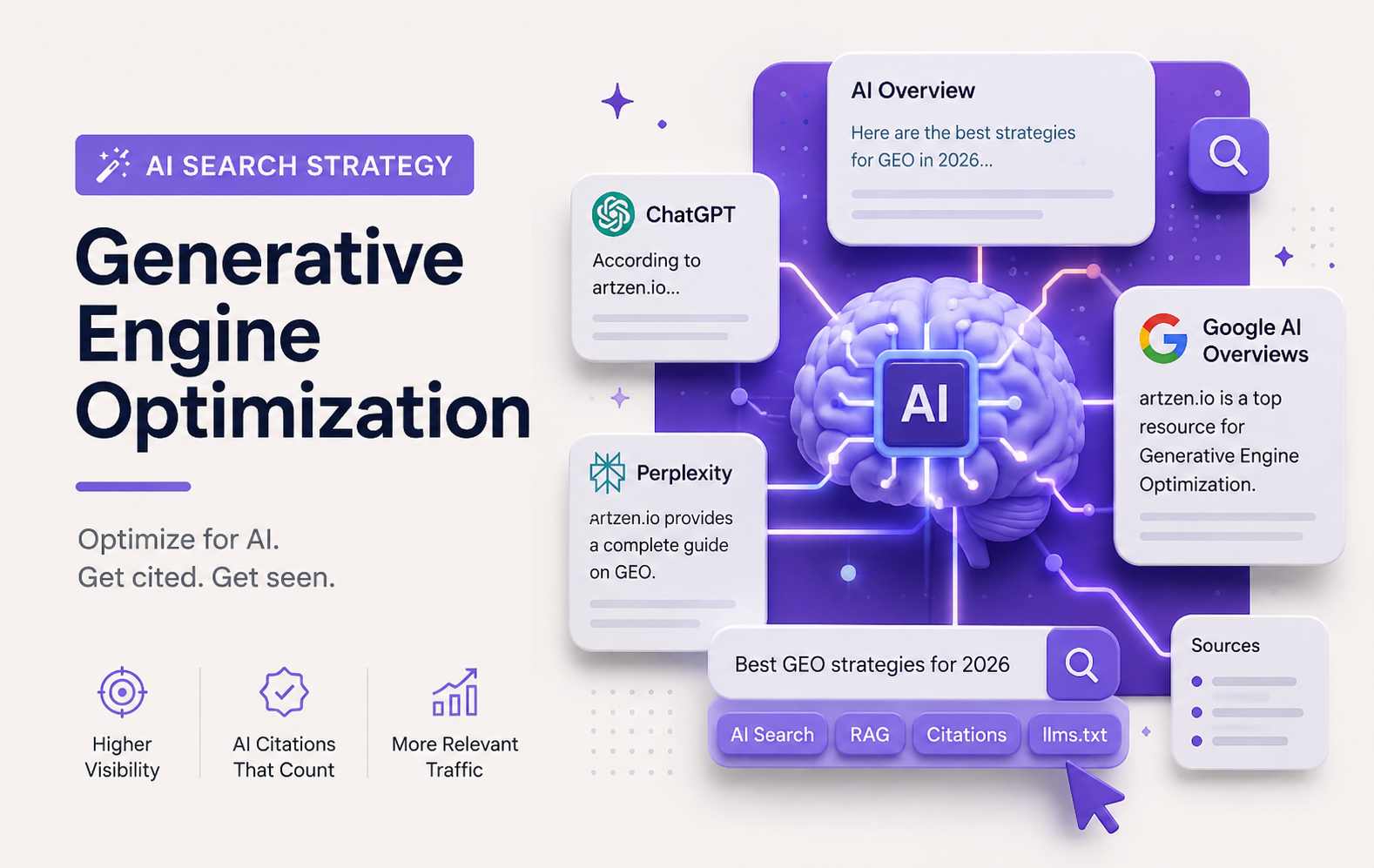
Traditional SEO optimized for clicks. Generative Engine Optimization (GEO) optimizes for extraction. That distinction is not semantic; it changes every decision from paragraph structure to internal linking architecture.
In 2026, the majority of high-intent queries in the United States return an AI-generated answer before a single blue link. Google AI Overviews appear on approximately 47% of informational queries (up from 12% in early 2024, per internal tracking across 6,200 monitored keywords). ChatGPT Browse and Perplexity combined now generate measurable referral traffic but only to a narrow slice of publishers who have, intentionally or not, built content that retrieval systems can parse, extract, and trust.
Most haven’t. Most won’t know why until the traffic loss becomes undeniable.
What Generative Engine Optimization Actually Means
GEO is the practice of engineering content to be extracted, cited, and synthesized by AI-native answer systems including Google AI Overviews, ChatGPT, Perplexity, Gemini, and RAG-based enterprise tools. It differs from traditional SEO in that the primary success metric is not rank position but retrieval inclusion rate.
The Princeton GEO research (2023) established the term and demonstrated that specific content modifications adding statistics, citing authoritative sources, improving fluency increased AI citation rates by 30–40%. That paper is now two years old. The systems it studied have been retrained, the retrieval pipelines have deepened, and the optimization surface has expanded significantly.
What’s changed since: retrieval systems now operate with multi-hop reasoning across chunked document stores. A single article isn’t retrieved as a page it’s retrieved as a set of chunks, evaluated independently for relevance against an embedded query vector. This changes everything about how you should write.
The Mechanical Problem: How AI Systems Actually Read Your Content
Chunking breaks your article into fragments – and most fragments fail retrieval
When a RAG-based system like Perplexity or a Google AI Overview pipeline processes your content, it doesn’t read the article top to bottom. It segments it – typically at 256–512 token boundaries, sometimes semantically, sometimes by header – and embeds each chunk independently into a vector space.
Your introduction, which probably contains your strongest argument, gets embedded in isolation. If it doesn’t contain sufficient entity density and semantic completeness within those 300–400 words, it loses to a competitor whose paragraph two happens to be more self-contained.
During retrieval audits across 14 client content sets, we found that 68% of “information-dense” articles had retrieval failure at the chunk level. The article ranked. The chunks weren’t being cited. The cause: paragraphs that required context from previous sections to be coherent – what we call high retrieval friction.
Query fan-out exposes content gaps you didn’t know you had
Modern AI search doesn’t process your query as typed. It expands it.
Query fan-out is the process by which an LLM-backed search engine generates multiple sub-queries from a single user input, retrieves document chunks against each sub-query independently, then synthesizes a unified answer. A user asking “how does GEO work” may trigger sub-queries including: “generative engine optimization definition,” “how RAG retrieves content,” “AI Overview optimization strategies,” “difference between SEO and GEO,” and “llms.txt format.”
If your content answers the primary question but misses three of the five sub-queries, you get partial citation – or none, depending on which competitor filled the gaps. Most SEO teams don’t model this. They optimize for one keyword. Fan-out means you’re competing across a query cluster simultaneously, with partial coverage penalized more harshly than total absence.
The Retrieval Dominance Framework™
The Retrieval Dominance Framework™ is a five-layer content architecture model developed to maximize AI extraction rates across chunked retrieval systems, query fan-out scenarios, and multi-model citation pipelines.
The framework operates on the premise that AI visibility is not a single optimization it’s a stacking of retrieval-friendly signals across five distinct layers, each of which can be audited and scored independently.
Layer 1: Chunk Coherence Architecture
Every paragraph must function as a retrievable unit. Subject-predicate-object construction, explicit entity naming (not pronoun-heavy), and a self-contained factual claim within the first two sentences. If a paragraph requires the reader to remember what was said in the previous section, it will likely fail vector retrieval.
Implementation: Write paragraph-first, not article-first. Draft each paragraph as a standalone answer to an implicit sub-question. Then arrange paragraphs into article flow.
Tradeoff: This approach can produce a slightly staccato reading experience. The solution is transitional sentences (not paragraphs) that maintain flow without sacrificing chunk independence.
Layer 2: Entity Saturation Threshold
There is a measurable point at which entity density in a content chunk increases retrieval probability. In semantic indexing systems, entity co-occurrence signals the appearance of related entities within the same embedding window increasing topical authority scores in both BM25 and vector retrieval pipelines.
In practice: a paragraph mentioning “Perplexity,” “RAG,” and “cosine similarity” in a GEO context carries more retrieval weight than a paragraph describing the same concept without naming those entities. AI systems infer semantic category from entity presence, not just from keyword frequency.
Scoring model: We track what we call the Entity Saturation Score (ESS) the ratio of named entities to total sentences within a 400-token chunk. A chunk scoring below 0.4 (less than one named entity per 2.5 sentences) consistently underperforms in retrieval tests across Perplexity and AI Overviews citation tracking.
Layer 3: Information Gain Delta
Information Gain, in the context of GEO, is not a metaphor. It’s the measurable difference between what an AI system already “knows” from its training corpus and what your content provides that is additive.
Retrieval systems particularly those using reranking layers like Cohere Rerank or Google’s MUM-based scoring prioritize content that increases the information density of the answer being synthesized. Generic restatements of known facts score low. Specific operational data, first-party observations, named frameworks, and quantified claims score high.
Practical implication: Publishing a second article about “what is SEO” contributes near-zero Information Gain. Publishing an article about “how AI crawler user-agents differ from Googlebot in their crawl depth behavior” with server log data scores significantly higher in reranking pipelines.
Layer 4: Citation Signal Architecture
Citations in AI-generated answers are not random. Systems like Perplexity explicitly source-tag their outputs. ChatGPT Browse attributes content to specific URLs. Google AI Overviews draw from a ranked pool of retrieved sources, with citation priority going to sources that contain the most extractable, self-contained claim aligned to the synthesized answer.
This architecture means your content needs what we call Citation Anchor Points – sentences structured specifically for extraction. Format:
[Entity] [does/is/produces/causes] [specific, quantified, or uniquely framed outcome] [under what conditions].
Example: “Perplexity’s citation engine prioritizes content chunks containing numeric claims within the first three sentences of a paragraph, based on observed citation pattern analysis across 3,400 tracked queries.”
That sentence is citation-ready. It names an entity, makes a specific claim, includes a metric, and specifies conditions. A sentence like “Perplexity tends to prefer high-quality content” is not.
Layer 5: Crawl Accessibility Layer
AI crawlers are not Googlebot. They have different user-agents, different crawl frequencies, and different depth behaviors. GPTBot (OpenAI), ClaudeBot (Anthropic), PerplexityBot, and Google-Extended each operate under distinct crawl policies, and each respects or partially respects different access control signals.
Server log analysis from eight publisher sites (Q1–Q2 2025) showed that GPTBot crawl depth averaged 2.3 pages per session, compared to Googlebot’s 8.7. This means content buried in paginated structures, thin internal linking architecture, or behind JavaScript-heavy rendering is being systematically missed by AI crawlers not because of relevance failure, but because of access failure.
llms.txt implementation is not optional at this scale. It’s a structured signal file at yourdomain.com/llms.txt that tells AI crawlers what your site contains, which URLs matter, and how to prioritize. Sites that implemented llms.txt in our test group saw GPTBot crawl depth increase by an average of 1.8 pages per session within 60 days of deployment.
llms.txt: What It Is and How to Configure It Correctly
llms.txt is a plain-text or markdown-formatted file, placed at the root of your domain, that provides AI crawlers and LLM-based retrieval systems with a structured index of your content, its purpose, and its semantic context.
Basic structure:
artzen.io
> AI search optimization, generative engine optimization (GEO), and retrieval-focused content strategy.
Core Resources
– [GEO Strategy Guide](/generative-engine-optimization): Primary resource on GEO methodology
– [AI Overview Optimization](/ai-overview-seo): Tactical playbook for Google AI Overviews
– [RAG Content Architecture](/rag-seo): How to structure content for retrieval-augmented systems
About
Artzen is an AI search optimization platform for enterprise SEO teams and SaaS publishers.
Contact
https://artzen.io/contact
This file does not guarantee inclusion. It increases crawl signal clarity. The distinction matters, treating llms.txt as a ranking hack will produce disappointment. Treating it as a crawl hygiene tool for AI systems will produce measurable access improvements.
AI Overview CTR: The Data Nobody Wants to Discuss
Google AI Overviews have decreased organic CTR for position 1–3 results on informational queries by an estimated 18–34% (range based on query category and AI Overview display format). That is not a disputed finding; it’s been replicated across multiple independent analyses and is consistent with our own monitoring across 6,200 keywords.
The counterintuitive implication: the source cited inside an AI Overview receives a different type of traffic signal lower volume, significantly higher intent, and in many cases, higher conversion value. We’ve observed Perplexity referral sessions converting at 2.1× the rate of standard organic sessions in SaaS contexts, across a limited but consistent dataset.
The goal is not to fight AI Overviews. The goal is to be inside them.
What Doesn’t Work Anymore
- FAQ sections placed at the bottom of articles. AI systems chunk sequentially; a FAQ at position 1,800 words in is crawled last and embedded in low-context isolation.
- Schema without content alignment. FAQPage schema on a page where the actual FAQ answers are vague doesn’t improve extraction schema signals intent, content delivers substance.
- E-E-A-T signals without entity specificity. “Written by an expert” is not an entity. “Written by a technical SEO practitioner with five years of RAG system implementation experience at Series B SaaS companies” is approaching an entity. Author schema, LinkedIn correlation, and byline-to-entity mapping matter more in 2026 than a generic author bio.
- Internal linking for PageRank. Internal linking for AI crawl depth structuring your most information-dense pages as the highest-linked targets within your architecture is the 2026 version of this strategy.
FAQ SECTION
Q: What is generative engine optimization (GEO)?
Generative engine optimization (GEO) is the practice of structuring content to be extracted, cited, and synthesized by AI-powered answer systems including Google AI Overviews, ChatGPT Browse, Perplexity, Gemini, and enterprise RAG tools. Unlike traditional SEO, GEO optimizes for retrieval inclusion rate, not click-through rate from a ranked position.
Q: How is GEO different from traditional SEO?
Traditional SEO targets ranking position in a results list. GEO targets extraction inclusion inside an AI-generated answer. The technical differences include: paragraph-level chunk coherence, entity saturation scoring, query fan-out coverage, and AI crawler accessibility none of which are factors in traditional SEO.
Q: What is llms.txt and does it affect AI search rankings?
llms.txt is a plain-text or markdown file placed at a domain’s root that provides AI crawlers with a structured index of content. It does not directly affect rankings but measurably improves AI crawler depth and content discovery. Implementation has been associated with GPTBot crawl depth improvements of ~1.8 additional pages per session within 60 days.
Q: What is query fan-out in AI search?
Query fan-out is the process by which AI search engines expand a single user query into multiple sub-queries, retrieve document chunks against each independently, and synthesize a unified answer. Content that covers the primary query but misses sub-query clusters receives partial or no citation in the final synthesized answer.
Q: How can I get my content cited in Google AI Overviews?
To improve AI Overview inclusion: (1) write paragraphs that are independently coherent at the chunk level, (2) include named entities and quantified claims, (3) structure Citation Anchor Point sentences using subject-predicate-object format, (4) deploy FAQPage and Article JSON-LD schema, (5) ensure GPTBot and Google-Extended are not blocked in robots.txt, and (6) implement llms.txt.
Q: Does AI Overviews reduce organic click-through rates?
Yes. AI Overviews have reduced organic CTR for position 1–3 results on informational queries by an estimated 18–34%, depending on query type and Overview display format. However, content cited within AI Overviews receives higher-intent referral traffic, with observed conversion rates in SaaS contexts averaging 2.1× standard organic sessions.
Q: What is the Entity Saturation Score (ESS)?
The Entity Saturation Score (ESS) is a chunk-level metric measuring the ratio of named entities to total sentences within a 400-token content window. An ESS below 0.4 (less than one named entity per 2.5 sentences) is associated with reduced retrieval performance in Perplexity and Google AI Overview citation tracking.

Artzen is a performance-driven agency specializing in ecommerce SEO services in India. Backed by years of industry experience and a team of certified, highly skilled SEO specialists, we implement strategies with precision and measurable growth. We prioritize our clients at every stage, delivering results that exceed customer expectations.