30 Jun
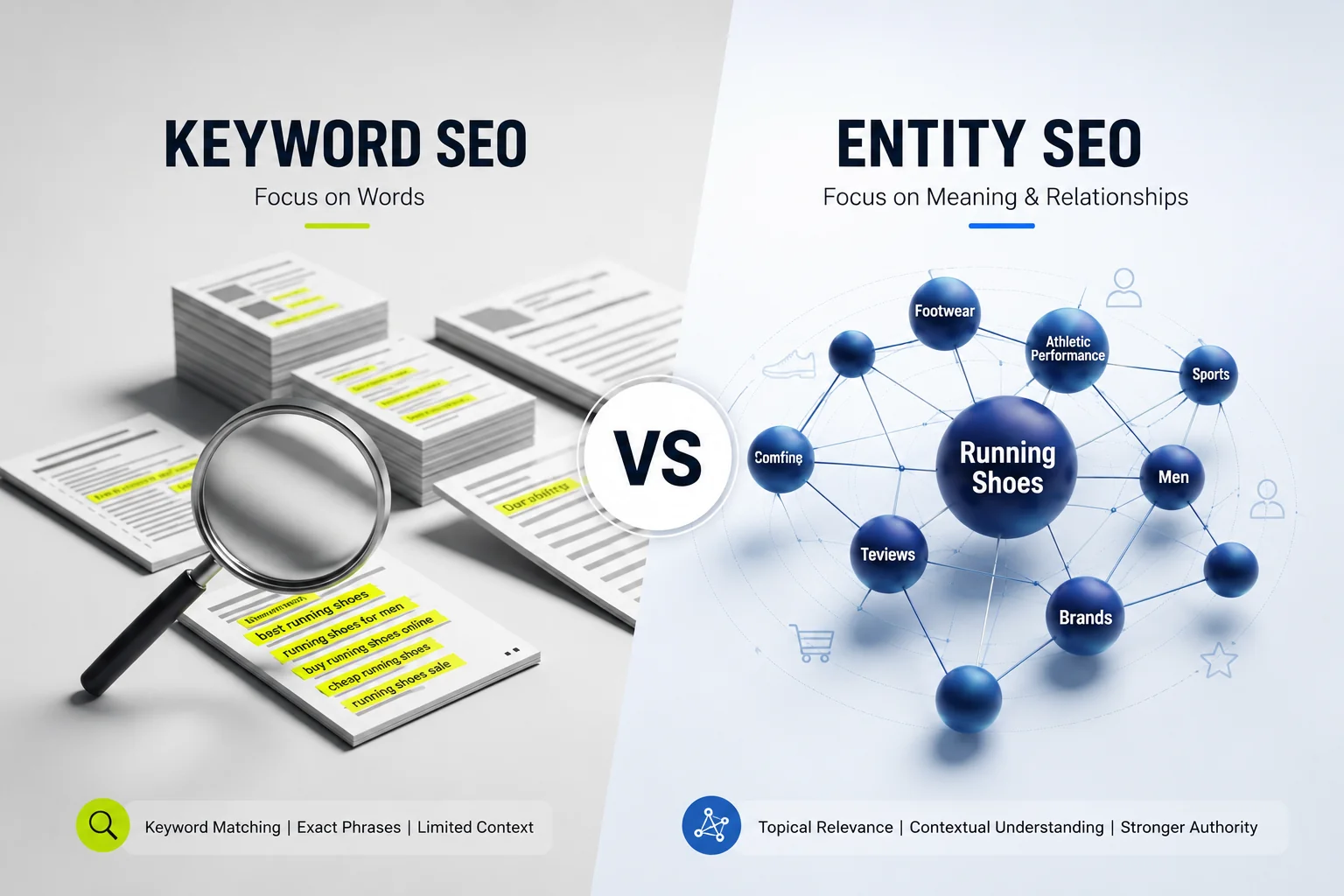
Search engines have changed fundamentally over the past decade. The question is no longer whether to use keywords – it is whether keywords alone are enough to compete in modern search.
The debate around keyword SEO vs entity SEO reflects a genuine shift in how Google and other search engines process language, assign authority, and rank content. Understanding both approaches, and how they interact, is essential for any site that wants to build lasting organic visibility.
What Is Keyword SEO?
Keyword SEO is the practice of researching specific words and phrases that users type into search engines and then optimizing content to rank for those terms.
The foundational workflow includes:
- Identifying target keywords using tools such as Google Keyword Planner, Ahrefs, or Semrush
- Matching those keywords to specific pages on a site
- Incorporating keywords into titles, headings, meta descriptions, body copy, and image alt text
- Building backlinks using keyword-rich anchor text
Keyword SEO dominated search optimization from the early 2000s through roughly the early 2010s. Its logic was straightforward: if a user typed “best running shoes,” a page that mentioned “best running shoes” repeatedly had a signal that it was relevant to that query.
The core limitation of pure keyword SEO is that it treats language as a string-matching exercise. Search engines operating on keyword frequency alone could be manipulated through keyword stuffing, exact-match anchor text, and thin pages targeting narrow queries. Google’s algorithm updates including Panda (2011), Hummingbird (2013), RankBrain (2015), BERT (2019), and MUM (2021) each moved the system further away from simple string matching toward genuine language understanding.
What Is Entity SEO?
Entity SEO is the practice of optimizing content and site presence around entities – the distinct, real-world objects and concepts that search engines recognize and organize through structured knowledge systems.
An entity, in the context of search, is anything that is uniquely identifiable and distinguishable from everything else. According to Google’s own documentation, an entity can be:
- A person (Marie Curie, Elon Musk)
- A place (Paris, the Grand Canyon)
- An organization (NASA, the World Health Organization)
- A product or brand (iPhone, WordPress)
- A concept (inflation, photosynthesis, machine learning)
Google’s Knowledge Graph, introduced in 2012, is the infrastructure that stores and connects entities. As of recent estimates, the Knowledge Graph contains hundreds of billions of facts about entities and their relationships. When Google understands that “Apple” in a technology article refers to the company rather than the fruit, that is entity recognition at work.
Entity SEO involves:
- Establishing your brand, person, or organization as a recognized entity
- Creating content that clearly defines and connects to related entities
- Using structured data (Schema.org markup) to communicate entity relationships to search engines
- Building mentions and citations on authoritative external sources
- Aligning content with topic clusters that reinforce topical authority
How Search Engines Shifted from Keywords to Entities
The transition was gradual but decisive.Google Hummingbird (2013) was the first major signal. Rather than matching individual keywords, Hummingbird interpreted the conversational meaning of an entire query. A search for “what is the capital of the country that borders France to the north” required understanding relationships between entities – not just matching words.
RankBrain (2015) introduced machine learning to interpret queries Google had never seen before, estimating intent based on contextual signals rather than exact keyword matches.
BERT (2019) enabled Google to process the full context of every word in a query by considering the words that come before and after it. BERT is particularly effective at understanding prepositions and nuanced phrasing that keyword models handled poorly.
MUM (2021) extended these capabilities further, processing text, images, and eventually video across multiple languages to understand complex, multi-step queries.
Each of these updates reinforced the same direction: search engines moved from counting words to understanding meaning, which is the domain of entity-based knowledge.
Keyword SEO vs Entity SEO: A Direct Comparison
|
Feature |
Keyword SEO |
Entity SEO |
| Core unit | Search term / phrase | Real-world object or concept |
| Primary signal | Keyword frequency and placement | Entity recognition and relationships |
| Content approach | Optimize for exact and near-exact match terms | Build topical authority around subjects |
| Link strategy | Keyword-rich anchor text | Brand and entity mentions and citations |
| Structured data | Limited use | Central to implementation |
| Algorithm alignment | Pre-2013 Google | Post-Hummingbird, BERT, MUM |
| Scalability | Vulnerable to algorithm changes | More durable long-term |
| Example | Ranking for “affordable dentist London” | Establishing a dental practice as a trusted local health entity |
Why Entity SEO Matters for Topical Authority
One of the most significant practical differences between the two approaches is how they build authority over time.
Keyword SEO tends to produce isolated pages, each targeting a specific term. Entity SEO encourages the creation of interconnected content that signals comprehensive expertise across a subject area. Google’s concept of topical authority rewarding sites that demonstrate depth of knowledge across a topic – aligns directly with entity-based thinking.
For example, a site that only publishes a page targeting “keyword SEO tips” demonstrates shallow commitment to the topic. A site that covers keyword research, semantic search, Knowledge Graph optimization, structured data, BERT, natural language processing in SEO, and entity disambiguation signals genuine subject matter authority. The entities across all of those pages reinforce each other.
This is why entity SEO is increasingly associated with E-E-A-T (Experience, Expertise, Authoritativeness, and Trustworthiness) – the framework Google uses to evaluate content quality. Demonstrating authorship, citing recognized sources, being mentioned on credible external sites, and publishing comprehensive content all contribute to entity-level authority.
Can You Use Keyword SEO and Entity SEO Together?
Yes – and in practice, the most effective SEO strategies do exactly that.
Keywords remain valuable for several reasons:
- Search volume data is still keyword-based. Tools measure how often specific phrases are searched, and that data informs content decisions.
- On-page signals still matter. Google still reads words. A page about “compound interest” that never uses the phrase will face unnecessary friction.
- User language should be reflected. Writing for entities should not mean abandoning the language your audience uses. Natural keyword usage helps search engines connect your content to relevant queries.
The practical framework is to start with entities and express them through keywords.
- Identify the core entities and topics your content covers.
- Research the keywords users associate with those entities.
- Create content that comprehensively addresses the topic (entity-first thinking).
- Use relevant keywords naturally within that content (keyword-informed execution).
- Apply structured data to make entity relationships explicit for search engines.
- Build mentions and links from authoritative external sources.
This approach produces content that serves both traditional ranking signals and modern language understanding systems.
How to Implement Entity SEO Practically
Transitioning from a keyword-only approach requires specific tactical changes.
- Use Schema.org Markup
Schema markup tells search engines what type of entity your page, organization, or person represents. For a local business, LocalBusiness schema communicates the name, address, phone number, category, and geographic location as structured entity data.
- Establish Your Knowledge Panel Presence
A Google Knowledge Panel indicates that Google has recognized your brand or personal name as an entity. Claiming and verifying your entity through Google Search Console and maintaining consistent NAP (Name, Address, Phone) data across the web strengthens this recognition.
- Build Your Entity’s Wikipedia and Wikidata Presence
Wikipedia and Wikidata are primary sources Google uses to populate the Knowledge Graph. If your brand or subject qualifies for a Wikipedia entry, establishing one (following Wikipedia’s notability guidelines) creates a direct entity signal.
- Earn Mentions on Authoritative Sources
Backlinks matter, but unlinked brand mentions on high-authority sites also contribute to entity recognition. Press coverage, industry directories, academic citations, and government references all strengthen entity signals.
- Create Comprehensive Topic Clusters
Build content that covers a subject area thoroughly. A pillar page on a core topic, supported by cluster pages on related subtopics, creates an entity-rich content ecosystem that signals depth of expertise.
- Consistent Entity Naming
Use consistent names for people, organizations, and topics across all content. Inconsistent naming fragments entity signals. If your company name is “Brightfield Analytics,” use that exact name consistently, not “Brightfield,” “Brightfield Analytics LLC,” and “the analytics company” interchangeably.
Common Misconceptions About Entity SEO
Misconception 1: Entity SEO replaces keywords entirely.
Keywords remain a core part of how users express intent. The shift is in how search engines process and weight those keywords, not in their disappearance.
Misconception 2: Entity SEO is only for large brands.
Small businesses and niche publishers can build entity authority within their specific topic area. A local accountant can become a recognized entity in local search through consistent structured data, reviews, and authoritative mentions.
Misconception 3: Schema markup alone creates entity authority.
Structured data helps search engines read entity information more efficiently, but it does not fabricate authority. Schema markup must be backed by genuine content, real mentions, and verified business information.
Key Takeaways
- Keyword SEO optimizes for specific search terms. Entity SEO optimizes for recognized real-world concepts and their relationships.
- Google’s core algorithm updates from 2013 onward have progressively shifted search from keyword matching toward entity understanding.
- Entity SEO supports topical authority, E-E-A-T alignment, and more durable long-term rankings.
- Keywords remain useful tools the most effective approach combines entity-first strategy with keyword-informed execution.
- Practical entity SEO involves Schema markup, Knowledge Graph presence, consistent entity naming, and comprehensive topic coverage.
Frequently Asked Questions
What is the main difference between keyword SEO and entity SEO?
Keyword SEO focuses on specific search terms and their placement in content. Entity SEO focuses on real-world objects and concepts that search engines recognize through systems like Google’s Knowledge Graph. Entity SEO addresses the meaning behind language rather than the words themselves.
Is entity SEO replacing keyword SEO?
Entity SEO is not replacing keyword SEO – it is expanding it. Keywords are still used to research user intent and are still present in content. The difference is that modern search engines interpret keywords within an entity context rather than as isolated strings.
What is an entity in SEO?
In SEO, an entity is any uniquely identifiable real-world object, person, place, organization, or concept that a search engine can distinguish from everything else. Google’s Knowledge Graph stores entities and their relationships to help interpret search queries accurately.
Does Schema markup help with entity SEO?
Yes. Schema.org structured data communicates entity information to search engines in a machine-readable format. It helps search engines accurately identify what type of entity a page, business, or person represents, which can improve how that entity is understood and displayed in search results.
How do I know if my site has entity recognition from Google?
A Google Knowledge Panel appearing for your brand or name is one strong indicator of entity recognition. You can also check whether your organization appears in Google’s Knowledge Graph by searching your brand name and observing whether structured information appears in the right-hand panel.
Artzen is a performance-driven agency specializing in ecommerce SEO services in India. Backed by years of industry experience and a team of certified, highly skilled SEO specialists, we implement strategies with precision and measurable growth. We prioritize our clients at every stage, delivering results that exceed customer expectations.