13 May
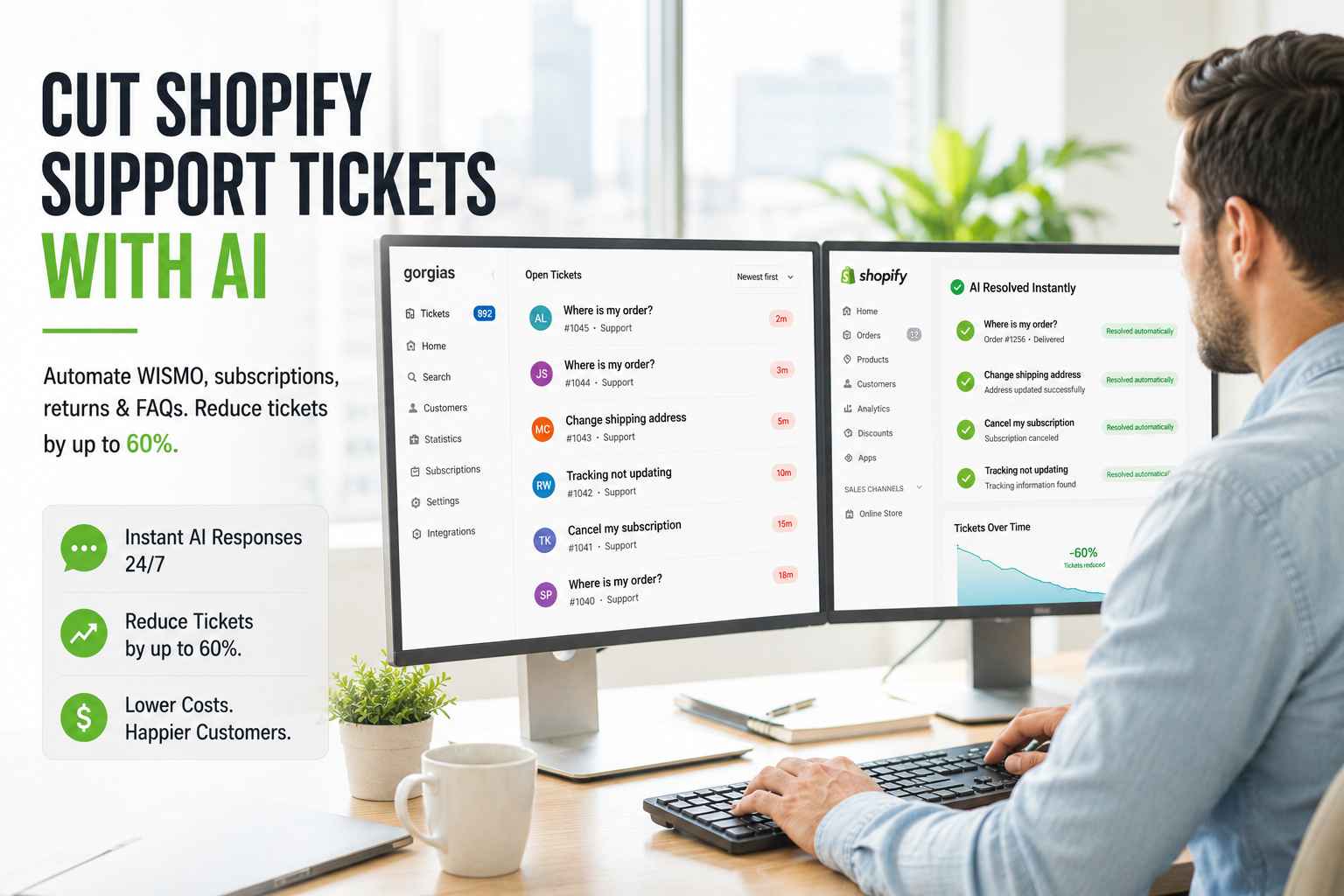
Every Shopify store owner knows the moment. You’ve just launched a new product, orders are flying in, and instead of celebrating, your support inbox looks like a digital riot. “Where’s my order?” “Can I change my address?” “How do I cancel my subscription?” Over and over and over again.
Your support team didn’t sign up to be a broken record. And yet, here we are.
The uncomfortable truth about Shopify customer support in 2025 is this: most of the tickets your team handles don’t require a human. They require the right information, delivered instantly, without someone having to check a spreadsheet or log into three different dashboards first.
This is exactly the problem that AI, and specifically ChatGPT-powered support systems, were built to solve.
Why Shopify Support Teams Are Drowning in Repetitive Tickets
If your team fields more than 100 support tickets a week, there’s roughly an 80% chance the same 8–12 questions are generating most of them. That’s not an exaggeration it’s a structural reality of ecommerce support.
Post-purchase anxiety is the silent engine behind most Shopify support volume. The moment a customer clicks “buy,” a psychological countdown begins. They want confirmation. Then they want tracking. Then they want the package. If any of those milestones are delayed or feel delayed they hit your support inbox.
“Where is my order?” queries (WISMO) account for anywhere from 35% to 50% of all inbound support tickets for mid-volume Shopify stores, according to data from support platforms like Gorgias and Re:amaze. Add return requests, subscription questions, address change requests, and basic product FAQs, and you’ve accounted for roughly 70–75% of all tickets before a genuinely complex issue ever arrives.
This is the support bottleneck nobody talks about clearly: your best agents are spending most of their day doing work a well-configured AI could handle in seconds.
The downstream effects are real. Response times suffer on the complex tickets that actually need human judgment. Agent burnout accelerates. Seasonal spikes become operational crises. And the cost of hiring more agents to handle repetitive queries is a cost that compounds without ever solving the underlying problem.
The fix isn’t more agents. It’s smarter triage.
What “Where Is My Order?” Queries Are Really Costing Your Store
Let’s put a number on this.
A mid-sized Shopify store processing 2,000 orders per month and averaging a 5% support contact rate fields roughly 100 support interactions per month tied directly to WISMO. At an industry-average handling time of 6–8 minutes per ticket and a blended agent cost of $18–$25/hour (factoring in salary, software, and overhead), that single query type costs between $180 and $340 per month from one repetitive question.
Scale that to a store doing 10,000 orders per month, and the math becomes uncomfortable fast.
But the financial cost isn’t even the most dangerous part. The hidden cost is opportunity cost. Every minute a trained support agent spends looking up an order status is a minute they’re not handling a refund escalation that could become a chargeback. Or a product complaint that, handled well, could turn a dissatisfied customer into a repeat buyer. Or a bulk order inquiry from a potential wholesale account.
WISMO automation isn’t just a cost-saving exercise. It’s a strategic reallocation of human intelligence toward the conversations that actually move the needle.
ChatGPT-integrated Shopify chatbots can handle WISMO queries by connecting directly to Shopify’s Order Status API in real time. The customer asks, the AI authenticates via email or order number, retrieves the current fulfillment status and tracking link, and responds all in under 3 seconds. No ticket created. No agent involved. No wait time.
How AI Reduces Shopify Customer Support Costs
AI reduces Shopify support costs through three distinct mechanisms, and understanding all three is what separates stores that see marginal gains from those that genuinely transform their operations.
- Ticket Deflection at Volume
The primary ROI lever. A well-deployed Shopify AI chatbot intercepts and resolves conversations that would otherwise become tickets. Deflection rates of 40–65% are achievable within the first 60–90 days of deployment for stores with high WISMO and FAQ ticket volume. This directly reduces the number of agent-handled tickets, allowing teams to either shrink in size or absorb volume growth without hiring.
- Triage and Routing Intelligence
Not all deflected tickets are full resolutions. AI excels at reading intent, tagging tickets by category, prioritizing by urgency, and routing complex issues to the right human agent with relevant context pre-populated. This alone can cut average handle time on escalated tickets by 20–35%, because agents aren’t starting from scratch.
- After-Hours and Global Coverage
Shopify stores are global by nature but support teams rarely are. AI support operates 24/7 across every timezone, eliminating the dead zones where unanswered queries turn into frustrated customers, negative reviews, and chargebacks. The per-interaction cost of AI at 2 AM is identical to the per-interaction cost at 2 PM.
The combined effect is a measurable reduction in cost-per-resolution, the most honest metric of support efficiency alongside improvements in customer satisfaction scores (CSAT), first response time (FRT), and overall resolution rates.
ChatGPT vs Human Support Agents: Real Cost Comparison
This comparison requires honesty, because the enthusiast framing (“AI replaces agents!”) misrepresents how the economics actually work in practice.
|
Metric |
Human Agent (Mid-Market) |
ChatGPT-Powered AI |
| Monthly cost per agent | $2,000–$4,500 (salary + overhead) | $50–$500 (platform + API usage) |
| Tickets handled per hour | 6–10 | 50–200+ (concurrent) |
| Availability | 40 hrs/week, single timezone | 24/7, global, no degradation |
| Consistency | Variable (fatigue, mood) | Consistent per configuration |
| Complex issue handling | High | Low without escalation design |
| Escalation capability | Direct resolution | Requires handoff workflow |
| Seasonal scaling | Expensive (hiring/training) | Instant (capacity scales with usage) |
| CSAT on simple queries | 70–80% | 75–88% (when well-configured) |
| CSAT on complex queries | 82–90%+ | 40–60% (without human fallback) |
The honest takeaway: AI isn’t a human replacement, it’s a force multiplier for the humans you keep. The stores that generate the strongest ROI from Shopify AI chatbots are the ones that route 60–70% of volume to AI and free their human agents to focus on the 30–40% that genuinely benefit from human judgment, empathy, and authority.
A two-person support team backed by well-configured AI routinely outperforms a six-person team without it not because the AI is smarter, but because the humans aren’t drowning in work that doesn’t require them.
Shopify AI Support Ticket Reduction: What the Data Actually Shows
There’s a lot of vague optimism floating around about AI ticket reduction percentages. Let’s separate the realistic from the aspirational.
What’s achievable in the first 90 days, for most Shopify stores:
- WISMO deflection: 40–60% of order status tickets fully handled without agent involvement
- FAQ deflection: 50–70% of policy, shipping, and returns questions resolved at first contact
- Overall ticket volume reduction: 30–45% for stores with high repetitive query ratios
What requires 6+ months of optimization to reach:
- 60%+ overall deflection rates
- Subscription management automation (cancel, pause, swap product, update billing)
- Proactive support triggering (AI identifies at-risk orders and reaches out before the customer complains)
The variables that matter most:
The single biggest factor in ticket reduction percentage is intent coverage how comprehensively you’ve trained or configured your AI to handle the specific query types your store generates. A generic chatbot with 20 pre-set responses will deflect 10–15%. A purpose-built AI integrated with your Shopify order data, returns policy, product catalog, and subscription platform will deflect 50–65%.
Shopify AI ticket reduction is not a product feature. It’s an implementation outcome.
WISMO Automation With AI: How to Actually Build It
“Where is my order?” is simultaneously the most common and most solvable support problem in ecommerce. Here’s how AI handles it end-to-end on Shopify.
The core workflow:
- Customer initiates chat and types a variant of “where is my order” (or 50 other phrasings – AI handles intent, not exact match)
- AI recognizes WISMO intent and requests order verification (email + order number, or email-only with magic link auth)
- AI calls Shopify’s Order Status API or connects via a fulfillment integration (ShipStation, EasyPost, AfterShip, etc.)
- AI retrieves current fulfillment status, carrier, tracking number, and estimated delivery date
- AI responds with a clear, human-readable summary and provides the tracking link
- If the order is delayed beyond estimated delivery, AI proactively acknowledges the delay and explains the next steps
- If the customer is still unsatisfied, AI escalates to a human agent with full conversation context
The variants that require additional configuration:
- Orders with multiple fulfillments (partial shipments)
- International orders using non-integrated carriers
- Orders where Shopify’s fulfillment status lags behind the carrier’s
- Orders that have been returned but not yet refunded
Each of these is solvable – but they require explicit escalation logic and aren’t handled out of the box by most turnkey AI chatbot platforms.
The proactive WISMO layer (advanced):
The most sophisticated Shopify stores don’t wait for customers to ask. They use AI-triggered proactive messaging: when an order hits a delay threshold (e.g., 2 days past estimated delivery with no scan update), the system automatically sends an update to the customer, preempting the support contact entirely. This reduces inbound contacts more effectively than reactive AI, because it addresses the anxiety before it becomes a ticket.
Shopify AI Chatbot Setup Guide: From Zero to Deflecting Tickets
Setting up a ChatGPT-powered Shopify AI chatbot is more approachable than most guides suggest but it requires more thought than most vendors admit.
Step 1: Define your deflection targets
Before installing anything, audit your last 90 days of support tickets. Categorize them by query type. Identify the top 8–12 categories that make up 70%+ of your volume. These are your deflection targets. Everything else is secondary.
Step 2: Choose your integration architecture
You have three options, each with different tradeoffs:
- Native Shopify app (lowest friction): Apps like Tidio, Reamaze, or Gorgias AI give you pre-built Shopify integrations and drag-and-drop AI configuration. Fastest to deploy. Less customizable.
- AI platform with Shopify connector (mid-tier): Platforms like Intercom, Zendesk AI, or Freshdesk Freddy plug into Shopify via API and offer more sophisticated intent modeling and workflow automation. Steeper setup, more powerful.
- Custom ChatGPT integration via OpenAI API (maximum control): Build your own AI layer using OpenAI’s API, connect to Shopify’s Admin and Order APIs directly, and create fully customized conversation flows. Highest flexibility, requires technical resources or a purpose-built tool like Artzen.
Step 3: Connect your Shopify data
For any meaningful WISMO and order management automation, your AI needs real-time access to:
- Shopify Order Status API
- Customer account data (with appropriate authentication)
- Fulfillment and tracking integrations
- Your returns and refund policy
- Product-level FAQs and inventory data (for “is this in stock?” queries)
Step 4: Configure escalation logic this is where most setups fail
A chatbot without a clear escalation path isn’t just unhelpful it’s actively damaging. Define explicit handoff triggers: specific query types that always route to human agents (e.g., payment disputes, complex return exceptions, complaints with anger signals in the language), confidence thresholds below which the AI asks for clarification rather than guessing, and time-based escalations (unanswered queries over X minutes automatically create a ticket).
Step 5: Train on your real support data
Upload your existing FAQ content, returns policy, shipping policy, and top historical support conversations (anonymized). This is what transforms a generic AI into a store-specific support specialist. The quality of this step determines 60–70% of your eventual deflection rate.
Step 6: A/B test your response quality
Deploy to a subset of traffic first. Monitor CSAT scores specifically on AI-handled conversations. Read the conversations where customers escalate despite the AI’s attempt to resolve these are your training data for the next iteration.
Step 7: Iterate monthly
AI chatbot performance isn’t a “set and forget” outcome. Shopify stores have seasonal patterns, new products, changing policies, and evolving customer language. Quarterly at minimum monthly for high-volume stores – revisit your intent coverage and response quality.
Agentic Commerce: When AI Doesn’t Just Answer, It Acts
Most Shopify AI chatbots today are sophisticated answer machines. Agentic commerce is what happens when AI stops answering and starts doing.
The distinction matters. A traditional chatbot tells a customer “To cancel your subscription, go to your account page and click…” An agentic AI cancels the subscription itself, confirms the cancellation, and asks if the customer would like to pause instead.
The difference in customer experience is significant. The difference in operational impact is transformational.
Agentic AI systems for Shopify can execute real actions with appropriate authorization:
- Cancel, pause, or modify subscriptions directly in platforms like Recharge, Bold, or Skio
- Process exchanges and initiate return labels via your 3PL or returns platform
- Apply discount codes or store credits as retention gestures during cancellation flows
- Update shipping addresses before fulfillment triggers
- Reorder a previous purchase on behalf of the customer
This is where ChatGPT’s function-calling capabilities become genuinely powerful for Shopify operators. By defining specific API functions the model can call your Shopify Admin API, your subscription platform API, your returns platform API you create an AI that doesn’t just know the answer but can execute the resolution.
The checkout-level applications are still emerging but directionally clear: AI-assisted reorders for subscription customers, dynamic upsell insertion during support conversations where the customer’s query reveals intent (a customer asking about a product compatibility issue is often moments away from a purchase decision), and proactive retention interventions during cancellation flows that achieve save rates comparable to trained human retention agents.
The honest implementation note: Agentic AI requires significantly more infrastructure and testing than a simple chatbot deployment. Action-capable AI introduces execution risk a mis-triggered cancellation or incorrect refund has real operational consequences. Human-in-the-loop design (AI recommends action, human approves for high-stakes operations) is the appropriate starting point for most Shopify stores.
Shopify Subscription Management Automation With ChatGPT
Subscription management is one of the most underserved areas of Shopify AI automation and one of the highest-value.
The typical subscription customer support contact looks like this: cancel, pause, swap product, update billing information, change delivery frequency, reactivate a lapsed subscription. None of these require a human being, but in most subscription businesses, all of them route to the support inbox because the customer doesn’t know where to find the self-service option.
ChatGPT-powered AI can handle the full subscription management lifecycle for Shopify stores running on platforms like Recharge, Skio, Bold Subscriptions, or Awtomatic, by connecting directly to their APIs.
The retention case for AI subscription management is particularly compelling. When a customer initiates a cancellation, a well-designed AI can:
- Identify the stated reason (too expensive, too much product, doesn’t work, found a better option)
- Match that reason to a relevant retention offer (discount for “too expensive,” skip option for “too much product,” product swap for “doesn’t work”)
- Present the offer conversationally, with natural language that doesn’t feel like a retention script
- Execute the retention action directly if the customer accepts
- Complete the cancellation cleanly if the customer declines, without friction or guilt
Human retention agents operating from scripts achieve save rates of 20–35% on cancellation intent. AI-powered retention flows, when well-designed, consistently achieve 25–40% save rates – with zero incremental labor cost and 24/7 availability.
For a subscription business doing $500K ARR with a 5% monthly churn rate, a 10 percentage point improvement in save rate translates to $25K+ in retained annual revenue. The AI that produces that outcome typically costs less than $500/month to operate.
Risks, Limitations, and the Case for Human Oversight
Anyone telling you AI can fully replace your Shopify support team without qualification is either selling something or hasn’t run ecommerce support before. Let’s be honest about where AI underperforms.
Where AI fails without careful design:
- Emotionally charged conversations. A customer who received a damaged product for a wedding gift and is upset is not asking for information – they need acknowledgment, empathy, and expedited resolution. AI that responds to emotional distress with process-oriented answers erodes trust and inflames situations.
- Edge cases outside its training data. AI is only as good as what it’s been configured to handle. Novel situations – a customs dispute on an international order, a payment processing error that’s created a billing discrepancy – require human judgment.
- Ambiguous intent. Customers don’t always express what they actually want clearly. “This doesn’t work” could mean a product defect, user error, or a mismatch between expectations and reality. Misclassifying intent and responding incorrectly creates a worse experience than not having AI at all.
- High-stakes resolutions. Disputes involving significant dollar amounts, potential chargebacks, or reputational situations should always route to human agents.
The oversight architecture that works:
The highest-performing Shopify AI support setups treat AI as the first layer, not the only layer. AI handles high-volume, low-complexity queries with speed and consistency. Human agents handle everything that requires empathy, authority, or judgment and they handle it faster because AI has absorbed the volume that was burning their bandwidth.
Escalation triggers should be explicit: defined query types, sentiment signals (anger, urgency), confidence thresholds, and customer tier (your top 10% of customers by LTV should always have direct human access as an option).
Audit AI conversations weekly in the first 90 days. The failure cases are your optimization roadmap.
Best AI Workflows for Shopify Support Teams
The most effective Shopify AI support implementations aren’t single chatbots. They’re layered workflows. Here are the five that deliver the most consistent ROI:
Workflow 1: WISMO Triage + Resolution Trigger: Customer initiates chat with order-related language Action: AI authenticates, retrieves order status, responds with tracking info and estimated delivery Escalation: AI flags delayed orders for proactive agent follow-up
Workflow 2: Returns + Exchange Automation Trigger: Return or exchange request Action: AI confirms eligibility, generates return label (via integrated 3PL), initiates exchange if applicable Escalation: Out-of-policy requests, high-value orders, items marked non-returnable
Workflow 3: FAQ Deflection Layer Trigger: Incoming email or chat with FAQ-matching intent Action: AI responds with policy-accurate answer pulled from your knowledge base Escalation: Low-confidence responses, customer follow-up indicating unresolved query
Workflow 4: Subscription Management Portal Trigger: Subscription modification request (cancel, pause, swap, billing update) Action: AI presents options, executes authorized action via subscription platform API Escalation: Billing disputes, reactivation with special circumstances
Workflow 5: Proactive Delay Outreach Trigger: Order exceeds estimated delivery window by 24–48 hours Action: AI sends proactive status update to customer, acknowledges delay, sets new expectation Escalation: Orders delayed more than 5 business days, carrier lost-in-transit status
The Future of AI Customer Support in Ecommerce
The trajectory of AI customer support isn’t toward replacing humans, it’s toward making human support dramatically more valuable and less exhausted.
In 2025, the gap between Shopify stores with intelligent AI support infrastructure and those without is visible in the unit economics: cost-per-resolution, CSAT at scale, agent-to-revenue ratios, and ability to grow without proportional support headcount growth.
In 12–18 months, the emerging capabilities that will reshape the landscape are:
Predictive support: AI that identifies customers likely to contact support before they do based on order velocity, past contact patterns, and delivery anomalies and intervenes with proactive communication that eliminates the contact entirely.
Sentiment-aware personalization: Support AI that adjusts its tone, pace, and resolution path based on real-time sentiment signals in the customer’s language, offering a de-escalation approach for frustrated customers without requiring human intervention.
Cross-channel memory: AI that knows a customer’s full support history across email, chat, SMS, and social DMs, eliminating the maddening experience of having to re-explain a problem to every new interaction point.
Agentic checkout recovery: AI that identifies checkout abandonment events connected to support-triggering friction (shipping cost confusion, discount code failures, address validation errors) and proactively resolves them via conversational outreach.
The stores that will win at customer experience in ecommerce are already building these systems today not because the technology is perfect, but because the operational advantage of getting there early compounds faster than most people expect.
FAQS
What is the average ticket reduction percentage for Shopify stores using AI?
For stores with high WISMO and FAQ ticket volume, AI-powered chatbots typically achieve 30–50% overall ticket reduction within the first 90 days of deployment. Stores with mature AI configurations and strong data integration report deflection rates of 55–70% on eligible query types.
Can ChatGPT be integrated directly with Shopify?
Yes. ChatGPT can be integrated with Shopify via the OpenAI API, connecting to Shopify’s Admin API, Order Status API, and third-party fulfillment integrations. Purpose-built platforms like Artzen simplify this integration without requiring custom development.
What is WISMO automation and why does it matter for Shopify?
WISMO (Where Is My Order) automation uses AI to respond to order status queries in real time by connecting to your Shopify order and fulfillment data. It matters because WISMO queries account for 35–50% of all Shopify support tickets and are entirely automatable without quality loss.
How does AI handle subscription management on Shopify?
AI connected to subscription platforms like Recharge, Skio, or Bold can process cancellations, pauses, product swaps, frequency changes, and billing updates directly. Advanced configurations include AI-driven retention flows that match a customer’s cancellation reason to a relevant retention offer before completing the cancellation.
What are the biggest risks of Shopify AI customer support?
The primary risks are: misclassifying intent on complex or emotionally charged queries, executing incorrect automated actions without adequate validation logic, and providing outdated or inaccurate information if knowledge bases aren’t maintained. All three are mitigated by well-designed escalation logic, regular content audits, and human oversight of high-stakes interactions.
What is agentic commerce in Shopify customer support?
Agentic commerce refers to AI that executes real actions within your Shopify ecosystem processing returns, modifying subscriptions, applying credits, updating addresses rather than simply providing information. It represents the evolution from conversational chatbots toward autonomous support agents that resolve issues end-to-end.
How long does it take to set up a Shopify AI chatbot?
Basic FAQ and WISMO chatbots can be deployed within 1–2 weeks using native Shopify apps or AI platforms with pre-built integrations. Custom ChatGPT integrations with full API connectivity typically require 4–8 weeks of development and testing. Full agentic commerce configurations (subscription management, automated returns) require 8–16 weeks for production-ready deployment.

Artzen is a performance-driven agency specializing in ecommerce SEO services in India. Backed by years of industry experience and a team of certified, highly skilled SEO specialists, we implement strategies with precision and measurable growth. We prioritize our clients at every stage, delivering results that exceed customer expectations.