29 Apr
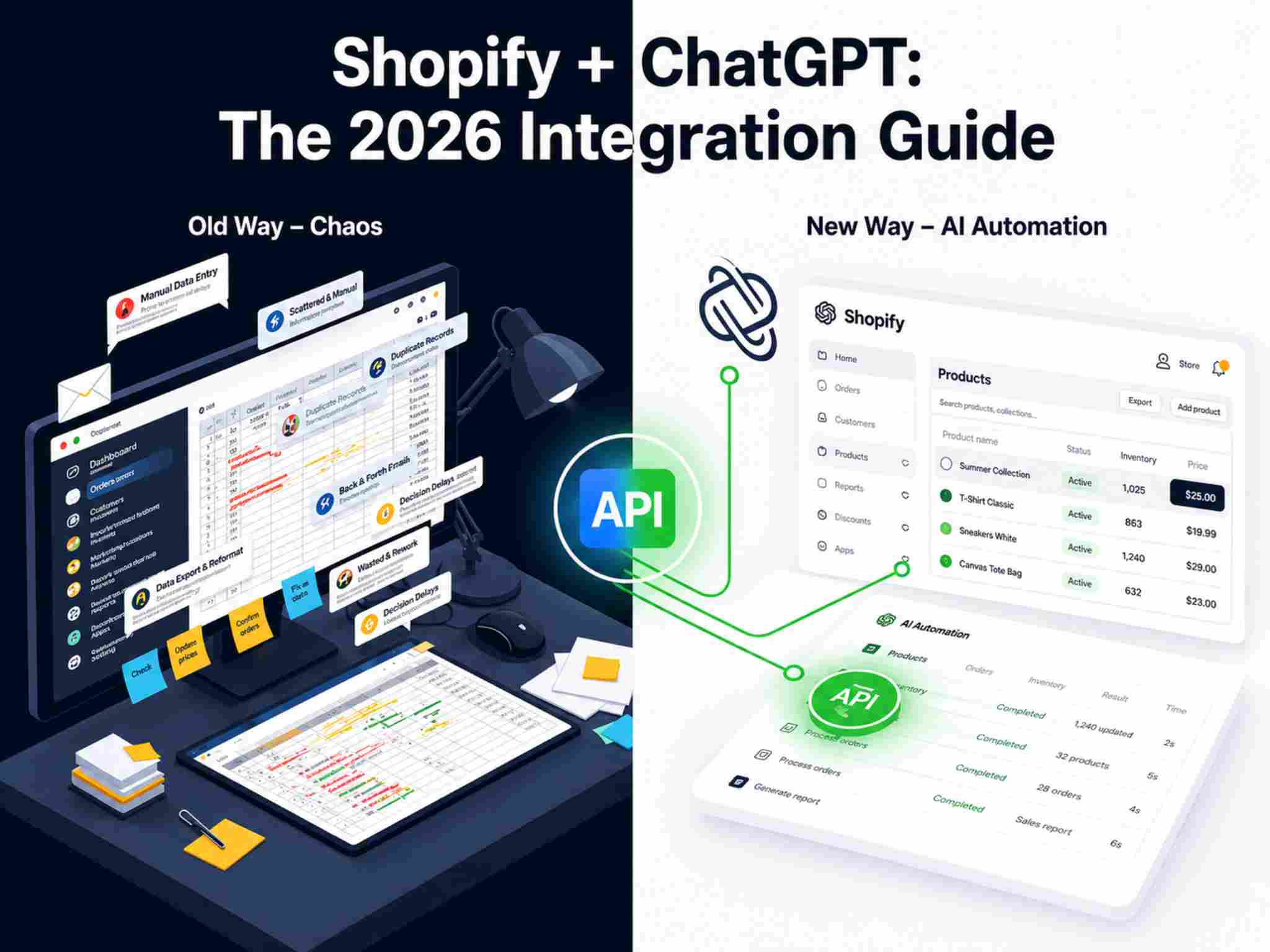
The best way to integrate ChatGPT with Shopify in 2026 is via OpenAI API + webhooks for full automation, Zapier for no-code workflows, or AI apps for fast setup. Custom API setups offer the most control, lowest cost, and best SEO outcomes.Catalog management and customer support are the two heaviest operational drags on a scaling D2C brand. If you are still writing meta tags manually or replying to “Where is my order?” tickets with copy-pasted macros, your overhead is bleeding into your margins.
This Shopify ChatGPT integration guide bypasses the generic advice you usually find. We are not just going to tell you to install a $39/month app. Whether you are an SEO manager looking to bulk generate Shopify content with AI, or a developer tasked to integrate OpenAI API with Shopify directly, this guide covers the exact frameworks, prompts, and architectures working in 2026.
What Most Articles Get Wrong About Shopify AI
If you search for Shopify AI tutorials, the top results usually pitch basic third-party apps that act as simple text wrappers. They miss the reality of modern e-commerce architecture.
- The Myth: AI content will tank your Shopify SEO.
- The Reality: Google’s Helpful Content system penalizes useless content, not AI content. If your AI integration generates highly specific, technically accurate descriptions using structured data, it ranks.
- The Missed Opportunity: Most store owners use ChatGPT as an external tool. They copy from a browser tab and paste into Shopify. The actual leverage comes from headless automation—pushing data via APIs and webhooks so the AI works in the background.
3 Ways to Integrate OpenAI API with Shopify
Depending on your agency’s resources or your technical chops, there are three primary ways to bridge the gap between OpenAI and your storefront.
Method 1: Connect ChatGPT to Shopify Without Apps (Custom API Setup)
Best for: Developers and enterprise agencies wanting zero recurring app fees and total data control.
To connect ChatGPT to Shopify without apps, you need a middleware layer (like Node.js hosted on Vercel or Cloudflare Workers) to securely hold your API keys.
- Set up Shopify Webhooks: Configure Shopify to send a JSON payload to your middleware whenever a new product is created (products/create).
- Process via OpenAI: Your middleware catches the webhook, extracts the raw product title and vendor specs, and sends a system prompt to the OpenAI API (using the gpt-4o-mini model for speed and cost efficiency).
- Push Back via Admin API: The middleware receives the formatted HTML description from OpenAI and uses a PUT request via the Shopify GraphQL Admin API to update the live product page.
Method 2: Shopify ChatGPT Automation via Zapier
Best for: Store owners and SEO managers who want custom workflows without writing code.
Shopify ChatGPT automation via Zapier allows you to build multi-step workflows.
- Trigger: New Product in Shopify.
- Step 2 (Formatter): Strip HTML from existing vendor descriptions.
- Step 3 (OpenAI): Send prompt: “Rewrite this manufacturer description into a compelling D2C product narrative. Use short paragraphs. Output strictly in HTML.”
- Step 4 (Shopify): Update Product. Map the OpenAI output directly to the “Body HTML” field.
Method 3: Best ChatGPT Apps for Shopify 2026
Best for: Brands needing immediate deployment with zero configuration.
If you must use an app, avoid generic “AI writers.” The best ChatGPT apps for Shopify 2026 focus on specific, measurable tasks:
- Gorgias (AI Agent): For customer support. It ingests your store’s historical ticket data to train its responses.
- SearchPie / SEOAnt: For bulk meta-tag generation and alt-text automation based on product images.
- Matrixify (Combined with Excel/Sheets): While not inherently an AI app, exporting your store data via Matrixify, running an OpenAI script in Google Sheets, and re-importing is the most robust way to handle thousands of SKUs at once.
Framework: Automate Shopify Product Descriptions with ChatGPT
To successfully automate Shopify product descriptions with ChatGPT, you must move away from zero-shot prompting (asking it to just “write a description”). You need to feed it a strict framework.
Bulk Generate Shopify Content with AI
If you have 500 new SKUs from a supplier, doing this one by one fails.
- Export your product catalog to a CSV.
- Use an OpenAI API plugin for Google Sheets or Airtable.
- Apply a strict prompt to the description column.
- Export and upload the CSV back into Shopify.
Shopify AI SEO Optimization Prompts (Copy & Paste)
Your prompts need constraints. Use this template to force the AI to write high-converting, SEO-optimized copy:
System Prompt: You are an elite e-commerce copywriter and Technical SEO for a premium [Insert Niche] brand. Your tone is [Insert Brand Voice: e.g., witty, clinical, rugged].
Task: Write a product description based on the provided raw specs.
Rules: > 1. Start with a 2-sentence hook addressing the buyer’s primary pain point.
- Follow with a bulleted list of 4 key technical features.
- Do not use the words “revolutionary,” “unlock,” “delve,” or “transform.”
- Output the result in clean HTML using <h2>, <p>, and <ul> tags only. No markdown formatting.
Raw Specs: [Insert Variables Here]
Building a Custom ChatGPT Shopify Bot Tutorial
Basic chatbots that only offer tracking links are dead. In 2026, using ChatGPT for Shopify customer service requires RAG (Retrieval-Augmented Generation).
How it works:
Instead of letting the AI guess policies, you vectorize your shipping policies, return rules, and product manuals into a database (like Pinecone). When a customer asks a question via your storefront chat widget:
- The system searches your database for the specific policy.
- It feeds that exact policy to ChatGPT along with the user’s question.
- ChatGPT formulates a conversational, highly accurate response.
This ensures the AI never hallucinates a “free shipping” offer that doesn’t exist.
How to Use GPT-4o for Shopify Stores
With the rollout of GPT-4o, multimodal capabilities (vision and voice) changed the game for catalog management.
Instead of feeding the AI text specs, you can now pass the OpenAI API your product image URLs.
- Visual Meta Tags: Ask GPT-4o to analyze the product photo and generate highly descriptive alt-text for accessibility and Google Images SEO.
- Variant Generation: Feed the model an image of a garment and have it automatically tag the exact shade of color, material texture, and pattern type into your Shopify product tags for better storefront filtering.
What Real Users Are Asking (Reddit & E-commerce Forums)
We analyzed hundreds of threads on r/Shopify and r/SEO regarding AI integration. Here is what store owners are actually worried about:
- “Will Google penalize my store for AI descriptions?”
- The Verdict: No. Google’s core updates target low-effort content. If you use the API to format manufacturer jargon into readable, well-structured HTML that helps the user understand the product, Google rewards it.
- “ChatGPT sounds like a robot. How do I fix the tone?”
- The Verdict: Stop using the default web interface. You must use the API and configure the system_message. Feed the AI 3 examples of your best-performing human-written descriptions and instruct it to mimic the cadence and vocabulary.
Integration Comparison: App vs. API vs. Zapier
| Integration Method | Setup Time | Customization | Monthly Cost Profile | Best For |
| Custom API / Webhooks | High (Days) | Unlimited | Pay-per-token (Very Low) | Scaling Agencies & Enterprise |
| Zapier / Make.com | Medium (Hours) | High | $20 – $100+ / mo | Tech-savvy Founders |
| Shopify App Store | Low (Minutes) | Low | $15 – $250+ / mo | Beginners & Small Catalogs |
Frequently Asked Questions
Can I connect ChatGPT directly to Shopify?
Yes. You can connect ChatGPT to Shopify directly by using Shopify Webhooks to trigger events, processing the data through the OpenAI API via a custom middleware server, and pushing the updated content back using the Shopify Admin GraphQL API.
What is the best AI app for Shopify SEO?
The best apps in 2026 focus on bulk metadata and structured schema generation. Apps like SearchPie are highly rated, but custom Python scripts utilizing the OpenAI API offer more control and lower long-term costs for large catalogs.
How much does it cost to use the OpenAI API with Shopify?
Using the API is drastically cheaper than monthly app subscriptions. Generating a 300-word product description using gpt-4o-mini costs fractions of a cent. Automating a catalog of 1,000 products typically costs less than $2.00 in API credits.
Can ChatGPT handle Shopify returns and exchanges?
Yes, but it requires a custom build or an advanced helpdesk app like Gorgias. By connecting the OpenAI API to your Shopify order database and return portal via APIs, the bot can autonomously validate order windows and generate return labels.
Next Steps for Your D2C Architecture
Implementing a true Shopify ChatGPT integration is no longer a novelty; it is a baseline requirement for operational efficiency in 2026. Manual data entry and generic customer support macros actively throttle your ability to scale.
Whether you choose to build a custom middleware application to connect ChatGPT to Shopify without apps, or you want to deploy complex automation via Zapier, the key is structured data and strict prompt engineering.
Stop wrestling with your catalog. If you need a custom headless AI integration, technical SEO overhaul, or bespoke Shopify development, the team at Artzen.io builds e-commerce architectures designed to scale autonomously.
👉 Ready to automate your store? Contact Artzen.io today for a technical consultation, or download our free lead magnet: “The Ultimate Shopify AI Prompt Library.”
Artzen is a performance-driven agency specializing in ecommerce SEO services in India. Backed by years of industry experience and a team of certified, highly skilled SEO specialists, we implement strategies with precision and measurable growth. We prioritize our clients at every stage, delivering results that exceed customer expectations.