07 May
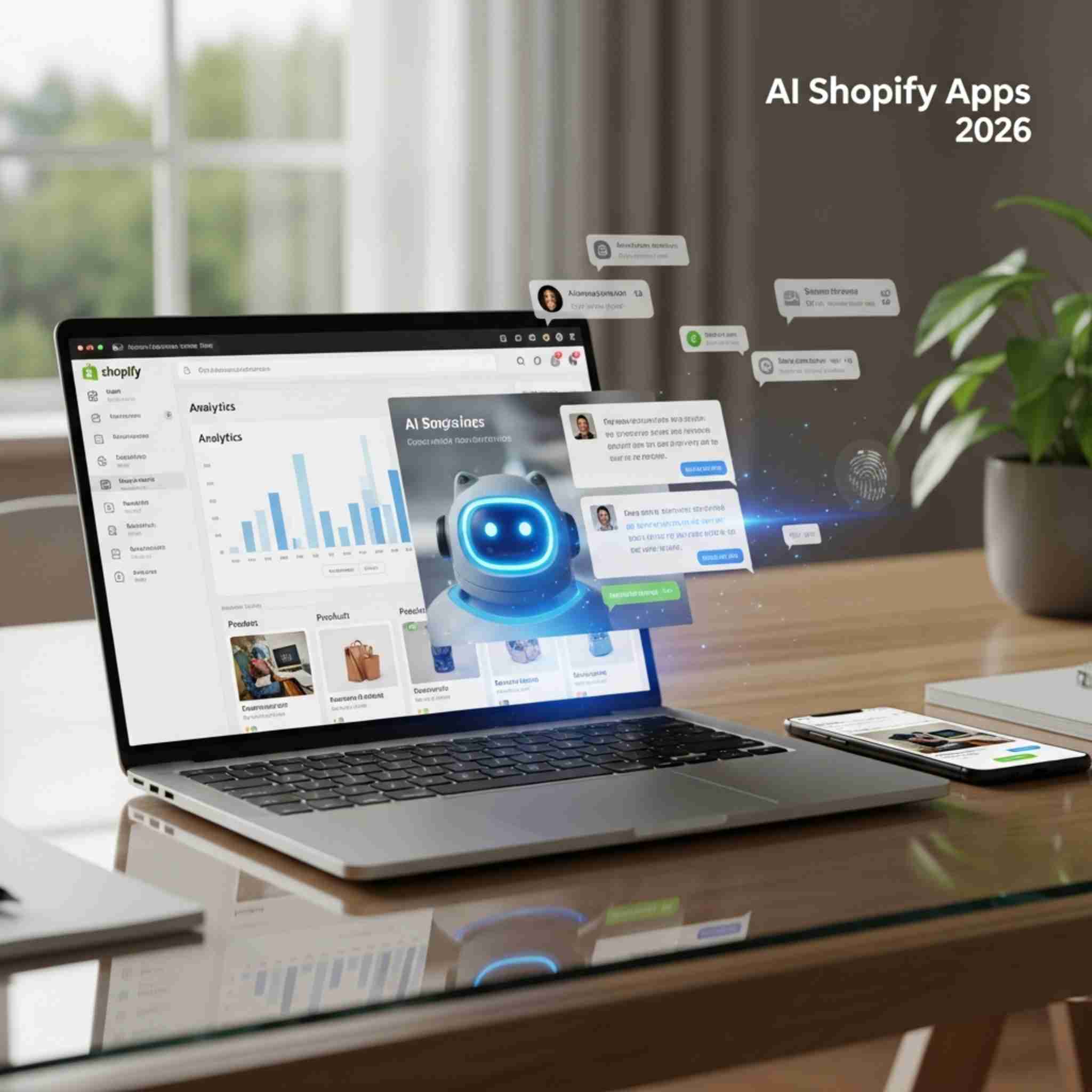
The best ChatGPT apps for Shopify in 2026 include Tidio AI, Gobot, Manifest AI, Describely, and Arena Commerce AI. Each offers distinct strengths — from live chat automation to AI-powered product recommendations and SEO content generation.
Here’s a scenario most Shopify store owners recognize: a customer lands on your product page at 11 PM, has two quick questions, gets no answer, and leaves. That’s a lost sale. Now multiply that across hundreds of visitors every week.
Meanwhile, your competitors are deploying AI assistants that respond instantly, recommend the right products, recover abandoned carts, and even rewrite product descriptions for better Google rankings all without hiring a single extra person.
The gap between stores using AI and those that aren’t is widening fast. In 2026, ChatGPT apps for Shopify are no longer a novelty they’re a competitive necessity. This guide breaks down the best options, how they actually work, and exactly how to set one up in under 30 minutes.
What Are ChatGPT Apps for Shopify?
ChatGPT apps for Shopify are AI-powered integrations built on large language models (LLMs) most commonly OpenAI’s GPT-4 or similar models that connect directly to your Shopify store. They can read your product catalog, order data, and customer history to have intelligent, context-aware conversations with shoppers.
Unlike basic chatbots that follow rigid decision trees, these tools understand natural language. A customer can type “I need a birthday gift for my mom who loves cooking, under ₹2000” and the AI will parse intent, browse your inventory, and suggest relevant items — all in seconds.
They function across multiple touchpoints:
- Live chat widgets on product and checkout pages
- Email and SMS follow-ups after browsing or abandonment
- Backend content tools that write SEO-optimized product descriptions
- Agentic storefronts that autonomously guide buyers through the entire purchase journey
Think of them as a 24/7 sales assistant, SEO writer, and customer support agent — rolled into one app.
Why Shopify Stores Need AI in 2026
Customer expectations have shifted dramatically. Speed is the new loyalty. Shoppers who don’t get instant answers don’t wait they bounce. With Google’s Search Generative Experience (SGE) and AI-native search engines like Perplexity and ChatGPT now influencing purchase decisions, your store’s content also needs to be AI-readable and optimized for conversational queries.
Some figures worth noting:
- 67% of online shoppers prefer chatbot support over waiting for a human agent
- Stores using AI recommendation engines report 3x higher conversion rates on suggested products
- The average Shopify store using AI chat sees a 40% reduction in support ticket volume within 90 days
The core pain points driving adoption in 2026 are rising ad costs (every visitor is expensive, and poor conversion rates destroy ROI), support team bottlenecks that can’t scale with traffic spikes, thin product content that doesn’t rank in AI search results, and cart abandonment sitting at a global average of around 70% much of it fixable with timely AI nudges.
Businesses using AI tools are seeing measurable improvements across every funnel stage. The question isn’t whether to adopt it’s which tool fits your store best.
Best ChatGPT Apps for Shopify (2026)
1. Tidio AI (Lyro) — Best Overall
Tidio combines live chat, email, and an AI chatbot called Lyro that’s trained on GPT-4. It learns from your FAQ content and resolves up to 70% of support queries without human involvement. The Shopify integration is seamless Lyro can check order status, process returns, and recommend products directly within the chat widget.
Standout feature: The “Reply Assistant” suggests AI-drafted responses to human agents in real-time, cutting response time by half even when a human is in the loop.
Key features include native Shopify order and product sync, multilingual support across 35+ languages, email and Messenger integration, and a detailed analytics dashboard.
Pros: Easiest setup of any AI tool on this list, free plan available for up to 50 conversations per month, excellent mobile app for agents, strong customer support.
Cons: Lyro AI requires a paid plan starting at $29/month, and advanced automation is limited on lower tiers.
Best for: Small to mid-size Shopify stores wanting an all-in-one support and sales tool with minimal configuration.
2. Manifest AI — Best for Product Discovery
Manifest AI is purpose-built for Shopify and uses GPT-4 to power a shopping assistant that understands intent, surfaces personalized products, and handles objections during the buying journey. Unlike generic chatbots, it’s trained specifically on ecommerce behavior patterns.
Standout feature: AI-powered “nudges” proactive messages triggered when a visitor shows exit intent or spends too long on a decision page that recover potential sales before they happen.
Key features include a GPT-4-powered product recommendation engine, automated quiz-style shopping flows, A/B testing for chat prompts, and integration with Klaviyo and Omnisend.
Pros: Highly conversion-focused features, beautiful and brand-customizable UI, strong analytics with revenue attribution.
Cons: More expensive than Tidio, and setup takes longer for large catalogs.
Best for: Mid-size to enterprise Shopify stores focused on increasing average order value and improving product discovery.
3. Gobot — Best Free Option
Gobot takes a quiz-first approach to AI shopping assistance. It guides visitors through a series of questions to understand their needs, then recommends the most relevant products. The AI layer ensures the conversation feels natural and adaptive rather than robotic.
Standout feature: The “Smart Quiz” builder uses AI to generate personalized buying guides based on your catalog no coding required.
Key features include a visual quiz builder with AI personalization, cart abandonment recovery flows, lead capture integration, and a functional free plan.
Pros: Generous free plan, great for stores with complex product catalogs, easy visual builder with no coding required.
Cons: Less powerful natural language understanding compared to Manifest AI, and customer support can be slow to respond.
Best for: Budget-conscious stores with varied product lines beauty, supplements, tech accessories.
4. Describely — Best for SEO Content
While not a chatbot, Describely is one of the most powerful ChatGPT Shopify integrations for SEO-focused content generation. It connects to your product catalog and bulk-generates SEO-optimized titles, descriptions, and meta tags using GPT-4 trained specifically on ecommerce copy.
Standout feature: Bulk generation for hundreds of products simultaneously, with brand voice consistency and keyword targeting built in.
Key features include bulk AI product description generation, direct Shopify sync with one-click publishing, SEO keyword optimization per product, and brand voice training.
Pros: Saves enormous time on content creation, directly impacts organic rankings, delivers consistent brand voice across the entire catalog.
Cons: Focused on written content rather than live chat, and human review is still needed for factual accuracy.
Best for: Stores with large catalogs suffering from thin, duplicate, or manufacturer-copied product content.
5. Arena Commerce AI Agent — Best for Agentic Commerce
Arena sits at the frontier of what’s called “agentic storefronts” AI systems that don’t just respond to questions but proactively act on behalf of customers. It can autonomously browse your store, add items to cart, apply discounts, and guide checkout all within a conversational interface.
Standout feature: Full checkout assistance via AI. The agent can complete purchases for users who simply describe what they want, dramatically reducing friction.
Pros: Most advanced AI capabilities currently available, reduces checkout friction significantly, future-proof for AI-native commerce.
Cons: Higher price point, still an emerging product that requires technical setup.
Best for: Enterprise Shopify Plus stores ready to lead in next-generation AI commerce experiences.
Quick Comparison Table
| App | Live Chat | Product Recs | SEO Content | Free Plan | Starting Price |
| Tidio AI (Lyro) | ✓ | ✓ | ✗ | ✓ | $0 / $29+ |
| Manifest AI | ✓ | ✓ | ✗ | ✗ | $49/mo |
| Gobot | ✓ | ✓ | ✗ | ✓ | Free |
| Describely | ✗ | ✗ | ✓ | ✗ | $19/mo |
| Arena AI Agent | ✓ | ✓ | ✗ | ✗ | Custom |
How to Choose the Right ChatGPT App for Your Shopify Store
The right choice depends on your primary goal. Use this simple framework.
Step 1 — Identify your #1 problem. High support volume points to Tidio AI. Low conversion rate points to Manifest AI or Gobot. Weak organic rankings point to Describely. Complex purchase journeys suit Gobot’s quiz flows. Future-proofing for AI commerce points to Arena.
Step 2 — Match to your store size. Small stores with under 500 SKUs benefit most from Tidio or Gobot. Mid-size stores with active marketing should consider Manifest AI. Large catalogs need Describely for content, potentially paired with a separate chat tool.
Step 3 — Set a clear success metric before installing. Is it ticket deflection rate? Conversion rate? Average order value? Having a KPI in mind before you go live makes it far easier to evaluate results within 30 days.
Pro tip: Most Shopify ChatGPT apps offer 14–30 day free trials. Run two tools simultaneously on different traffic segments before committing to a paid plan.
Real Use Cases: How Shopify Stores Are Using AI in 2026
Customer support automation: A fashion brand uses Tidio Lyro to handle 80% of “where is my order” queries automatically, freeing their support team to focus on complex issues and disputes. Their first-response time dropped from 4 hours to under 30 seconds.
Product recommendations: A skincare store uses Manifest AI to match customers to personalized routines through a conversational quiz. Their upsell rate jumped 34% within 60 days of going live without running a single extra ad.
SEO content generation: A home decor store rewrote 800 product descriptions using Describely in one week. Organic traffic increased 28% over the following 90 days as the AI-optimized descriptions began ranking for long-tail queries the original content had completely missed.
If you’re running a Shopify store and still writing product descriptions manually or relying solely on human support agents, you’re leaving measurable revenue on the table. These aren’t hypothetical improvements they’re documented outcomes from stores that implemented AI chatbot for Shopify solutions in the past year.
Step-by-Step Setup Guide: Installing a ChatGPT App on Shopify
Here’s how to go from zero to live with Tidio AI the most beginner-friendly option — in under 30 minutes.
Step 1 — Install from the Shopify App Store. Go to apps.shopify.com, search “Tidio Live Chat & AI Chatbots,” click Install, and approve permissions. The app installs in under two minutes.
Step 2 — Connect to your store data. In the Tidio dashboard, go to Integrations → Shopify. Enable product catalog sync, order tracking, and customer data access. This is what allows the AI to give accurate, store-specific answers rather than generic responses.
Step 3 — Train Lyro on your FAQs. Navigate to Lyro AI → Knowledge Base. Add your FAQ content — shipping times, return policy, sizing guides, warranty information. The more detailed your input, the more accurate Lyro’s answers will be from day one.
Step 4 — Configure conversation flows. Set up triggers show the chat widget after 15 seconds on product pages, or send a proactive message on checkout pages. Enable “handoff to human” for complex queries so nothing falls through the cracks.
Step 5 — Test before going live. Use Tidio’s preview mode to simulate customer conversations. Test edge cases: out-of-stock queries, international shipping questions, discount code requests. Fix gaps in your knowledge base before real customers find them.
Step 6 — Monitor and optimize weekly. Check the Analytics → Unanswered Questions report every week. Every unanswered query is a training opportunity. Add responses for the top 10 gaps each week for the first month this compounds into significantly better AI performance.
Shopify + ChatGPT SEO Strategy: The Unique Edge Most Stores Miss
Most content about ChatGPT Shopify apps focuses on customer support. That’s fine — but the real long-term ROI is in SEO. Here’s how AI reshapes your search visibility in 2026.
Product description optimization. Google’s algorithms increasingly reward specificity, semantic richness, and genuine helpfulness. AI-generated product descriptions when done right hit all three. Use tools like Describely to generate descriptions structured around long-tail queries your customers actually search, such as “lightweight running shoes for wide feet” rather than simply “running shoes.”
AI search visibility. AI search engines like SGE, Perplexity, and ChatGPT pull structured, authoritative product information. Your product pages need to answer the questions AI models are trained to respond to. This means writing descriptions that address what problem the product solves, who it’s designed for, and how it compares to alternatives — not just listing features and dimensions.
Working with a knowledgeable Best SEO Company in Panchkula can help you build an AI-visible content framework for your Shopify store one that ranks in traditional Google results and surfaces in AI-generated answers simultaneously.
The agentic storefront concept. This is the most forward-looking idea in AI ecommerce right now. An agentic storefront doesn’t just respond it acts. Imagine a customer telling your website: “I need a wedding gift for a couple who loves outdoor cooking, budget ₹5000.” An AI agent browses your store, bundles a relevant gift set, applies an appropriate discount, and presents a checkout link — all autonomously, without the customer clicking through multiple pages.
Shopify is actively building infrastructure for this direction. Stores that prepare their catalog with clean data, structured descriptions, and well-tagged products will have a significant advantage when agentic commerce becomes mainstream.
If you need a strategic partner who understands both AI trends and ecommerce SEO, the SEO Agency in Tricity team at Artzen builds future-ready SEO architectures for Shopify stores.
Common Mistakes to Avoid
Installing AI chat without training it on your store data. A generic chatbot that doesn’t know your products will give wrong answers and erode customer trust faster than having no chatbot at all.
Ignoring the unanswered questions report. This is the most valuable data your AI generates. Ignoring it means the same gaps persist indefinitely and customers keep hitting dead ends.
Using AI to replace all human support immediately. Start with AI handling Tier 1 queries FAQs, order status and humans handling Tier 2 issues like disputes and returns. Gradually expand AI scope based on confidence scores over time.
Generating AI content without a quality review step. AI product descriptions can contain inaccuracies, especially for technical or regulated products. Build a simple review workflow before bulk-publishing.
Choosing the most expensive app rather than the best fit. A premium enterprise tool doesn’t outperform a mid-tier tool if your store doesn’t have the traffic volume and support complexity to justify it.
Ignoring mobile experience. Over 70% of Shopify traffic comes from mobile devices. Test your AI chatbot on at least three different mobile devices before going live.
ROI & Performance Insights
The numbers around AI adoption in ecommerce in 2026 are difficult to ignore.
Stores using proactive AI chat on checkout pages report 12–18% recovery rates on abandoned sessions significantly above email-only recovery campaigns. The average AI chatbot for Shopify resolves 60–70% of queries without human involvement within 90 days of proper training. AI-generated, SEO-optimized product descriptions typically deliver measurable organic traffic improvements within 60–90 days, without ongoing ad spend. And AI recommendation engines that suggest complementary products at cart stage increase average order value by 15–22% according to multiple Shopify Plus merchant case studies.
The key insight is that AI tools compound over time. The more data they process, the better their recommendations and responses become. A store that starts implementing AI today will have a smarter, more profitable system in six months than a competitor who waits until next year.
Frequently Asked Questions
What is a ChatGPT app for Shopify?
A ChatGPT app for Shopify is an AI-powered integration that uses large language models like GPT-4 to automate customer interactions, recommend products, generate SEO content, and handle support queries directly within your Shopify store without requiring a human agent to be available around the clock.
What is the best ChatGPT app for Shopify in 2026?
The best overall option is Tidio AI (Lyro) for support and sales automation. For product discovery, Manifest AI leads the pack. For SEO content generation at scale, Describely is the top choice. The right app ultimately depends on your primary business goal and store size.
Is there a free ChatGPT app for Shopify?
Yes. Tidio and Gobot both offer free plans with core AI features. Tidio’s free plan includes up to 50 Lyro AI conversations per month enough to validate the concept before committing to a paid tier.
How do I install a ChatGPT chatbot on my Shopify store?
Go to the Shopify App Store, search for your chosen app, click Install, and approve the required permissions. Most apps then require syncing your product catalog and training the AI on your FAQ content before going live. The full process takes 30–60 minutes for a basic setup.
Does AI chat actually increase Shopify sales?
Yes – when implemented correctly. AI chatbots increase sales by recovering abandoned carts, providing instant product guidance that reduces decision paralysis, and offering upsells at the right moment in the buying journey. Stores using AI recommendation engines consistently report average order value increases of 15–22%.
Ready to turn your Shopify store into a 24/7 sales machine? Whether you need help choosing the right AI tool, optimizing your Shopify content for AI search, or building a forward-looking agentic storefront strategy – the team at Artzen has done it for dozens of ecommerce brands. Get in touch for a free strategy consultation.
Artzen is a performance-driven agency specializing in ecommerce SEO services in India. Backed by years of industry experience and a team of certified, highly skilled SEO specialists, we implement strategies with precision and measurable growth. We prioritize our clients at every stage, delivering results that exceed customer expectations.