03 Jun
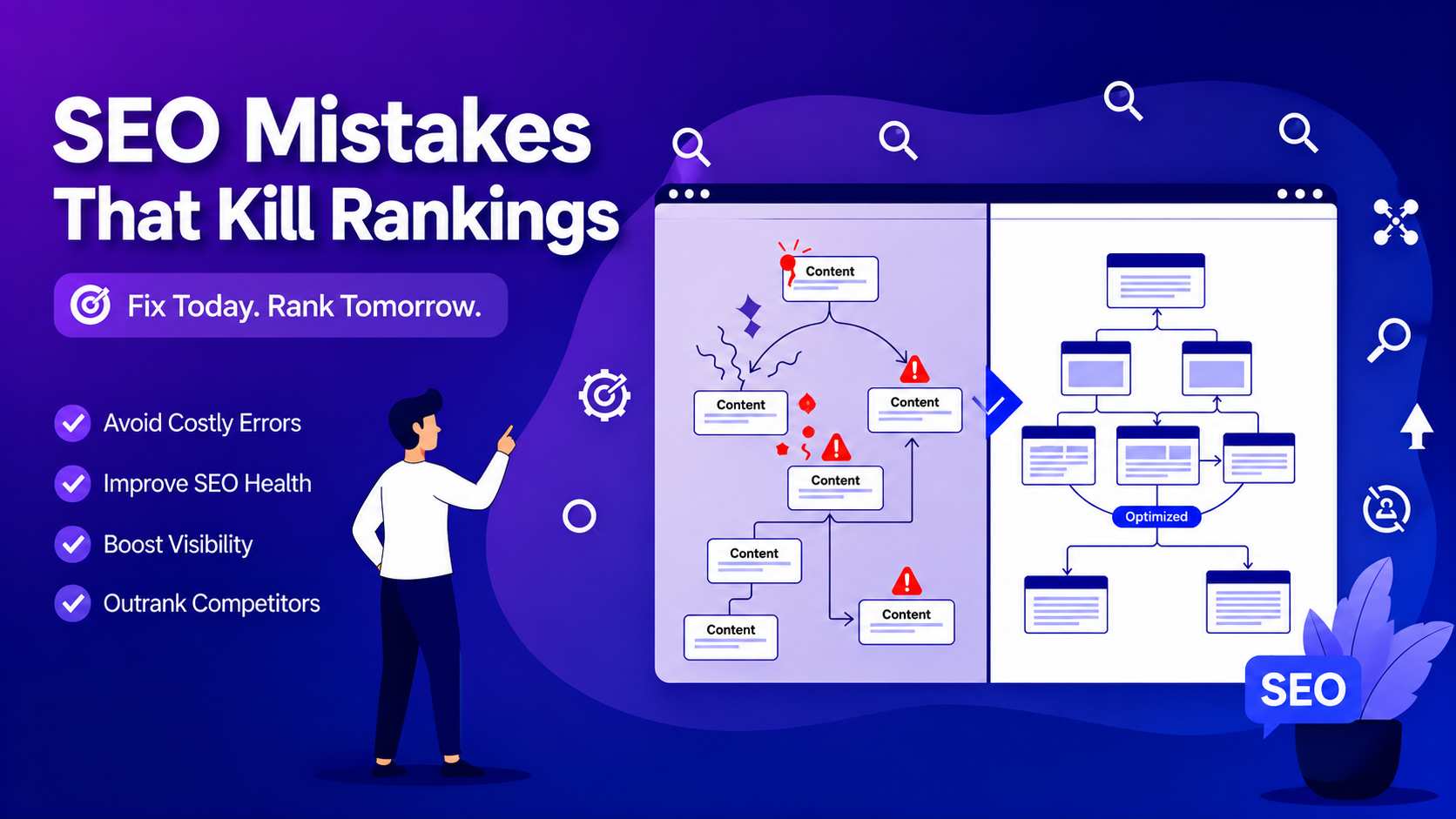
Your traffic dropped. Your rankings slipped. You ran an audit, fixed a few meta titles, maybe added some keywords and nothing changed.
Here’s the uncomfortable truth: the SEO mistakes that actually kill rankings in 2026 are rarely the ones getting attention in generic “SEO tips” articles. Most guides recycle surface-level advice while the real damage happens underneath in your site’s architecture, your content’s intent alignment, your technical signals, and your topical coverage gaps.
This article exists to close that gap. Whether you’re a Shopify store owner trying to figure out why your website is not ranking, a digital marketer running eCommerce campaigns, or an agency reviewing a client’s technical SEO audit what follows will change how you diagnose ranking problems.
No filler. No obvious advice. Just the mistakes most SEO content won’t go deep enough to explain
What Most Articles Get Wrong About SEO Mistakes
Search “biggest SEO mistakes” and you’ll get the same recycled list: duplicate content, missing meta descriptions, slow page speed, thin content.
That content isn’t wrong, it’s just three years behind.
Here’s what those articles consistently miss:
- They treat technical SEO as a checklist instead of a system
- They mention “search intent” but never explain structural intent failure
- They ignore the difference between AI content that passes and AI content that tanks rankings
- They don’t cover topical authority strategy as a foundational ranking requirement
- They haven’t caught up with Interaction to Next Paint (INP) replacing FID as a Core Web Vitals metric
- They overlook how information gain not just backlinks now influences ranking equity
The SEO landscape shifted decisively in 2024 and continues evolving in 2025–2026. Google’s Helpful Content system is now deeply integrated into the core algorithm. AI Overviews changed how featured snippets compete. Entity-based search rewards topical depth over keyword density.
If your current SEO strategy hasn’t adapted to these shifts, you’re not optimizing you’re treading water.
Mistake 1 Ignoring Search Intent at a Structural Level
Everyone says “match search intent.” Very few people explain what happens when you match the surface intent but fail the structural intent.
The Difference Between Matching Intent and Satisfying Intent
Matching intent means your content type aligns with the query. A listicle for “best Shopify apps,” a how-to for “how to add schema markup in Shopify” that’s surface-level intent matching.
Satisfying intent goes deeper. It means your page structure, content depth, internal linking, and UX signals tell Google that users completed their goal on your page.
Here’s where Shopify stores repeatedly fail:
- A category page ranks for a transactional keyword but has zero filtering options users bounce immediately
- A blog post ranks for an informational query but buries the answer under 400 words of preamble dwell time collapses
- A product page targets “buy X” queries but lacks trust signals, reviews, or clear CTAs conversion signals tank
Google’s RankBrain and behavioral signals read these patterns. If users consistently leave your page unsatisfied, your rankings erode not overnight, but predictably.
Fix the structural layer, not just the content layer. Ask: does my page complete the user’s task, or does it just address it?
Mistake 2 Publishing Low-Quality AI Content Without Validation
AI content isn’t the problem. Unvalidated, experience-free, scaled AI content is.
Why Google’s Helpful Content System Targets Scaled AI Output
Google’s Helpful Content system introduced a sitewide signal meaning low-quality content anywhere on your domain can suppress rankings across all your pages.
The pattern that triggers this: publishing large volumes of AI-generated content that lacks:
- First-hand experience (a core E-E-A-T requirement since late 2022, strengthened through 2025)
- Original data, perspective, or research
- Genuine utility beyond what already exists on the SERP
Real Reddit threads from Shopify store owners tell the same story: “I published 200 AI blog posts and my rankings dropped across my whole site.” That’s not a coincidence that’s the Helpful Content classifier doing its job.
What works in 2026:
- AI for structure and research acceleration → human expertise for validation and differentiation
- Adding real product testing data, customer quotes, or original analysis
- Writing for information gain the concept that your content should add something the top 10 results don’t already cover
What kills rankings:
- Bulk-generating category pages with thin AI copy
- Product descriptions that read identically across your catalog
- Blog content that summarizes existing articles without adding perspective
The question isn’t “did a human or AI write this?”- it’s “does this content deserve to rank?”
Mistake 3 Topical Authority Gaps That Signal Shallow Expertise
Topical authority is one of the most misunderstood concepts in modern SEO and one of the biggest reasons sites fail to rank despite having “good” individual pages.
Google evaluates your site as a topical entity. If you sell running shoes but you’ve only published content about “best running shoes,” you’re signaling surface-level expertise. Sites with content that covers the full topical ecosystem shoe fitting, gait analysis, injury prevention, training plans signal deep authority.
For Shopify stores, topical authority strategy gaps look like this:
|
What Stores Do |
What Actually Builds Authority |
| Blog only about products | Cover the full buyer journey ecosystem |
| Target high-volume keywords only | Include long-tail semantic variations |
| Publish randomly without content clusters | Build pillar → cluster → supporting page architecture |
| Ignore related entities | Include related concepts, tools, people, brands naturally |
A Shopify store selling supplements that only blogs about “protein powder benefits” is missing opportunities around nutrition science, workout recovery, ingredient sourcing, and customer transformation stories all of which build semantic depth that AI search engines and Google’s entity graph pick up.
The practical framework: Map your topical universe. Every core topic should have a pillar page, 3–8 cluster pages, and supporting FAQ or comparison content. Without this architecture, individual pages rank in isolation and isolated pages rarely sustain rankings.
Mistake 4 Technical SEO Mistakes That Quietly Drain Rankings
Technical SEO mistakes don’t announce themselves. They compound silently while you focus on content.
Core Web Vitals and Interaction to Next Paint (INP) Failures
In March 2024, Google officially replaced First Input Delay (FID) with Interaction to Next Paint (INP) as a Core Web Vitals metric. Many sites, especially Shopify stores running heavy app stacks still haven’t optimized for it.
INP measures the delay between any user interaction (click, tap, key press) and the browser’s next visible response. A poor INP score (above 200ms) signals a sluggish, unresponsive experience a direct ranking factor.
Common Shopify-specific INP failures:
- Overloaded JavaScript from third-party apps (review widgets, chat tools, loyalty apps)
- Render-blocking scripts in the theme head
- Heavy liquid template rendering on collection pages
- Unoptimized product image delivery
Crawl Budget Waste on Shopify Stores
Shopify’s URL structure generates significant crawl waste that most store owners don’t realize exists:
- Duplicate URLs from /collections/all and filtered URLs
- Paginated collection pages with no rel=”next” signals
- Variant pages indexed without canonical tags
- App-generated URLs consuming crawl budget
If Googlebot wastes crawl budget on low-value URLs, your critical pages product and category pages get crawled less frequently. In competitive niches, this directly impacts how quickly new content ranks.
Immediate audit actions:
- Run a crawl with Screaming Frog or Sitebulb
- Identify non-canonical indexed URLs
- Review Google Search Console for crawl anomalies
- Audit JavaScript-heavy pages using Chrome DevTools Lighthouse
Mistake 5 Treating an SEO Audit as a One-Time Event
This is perhaps the most expensive misconception in eCommerce SEO.
A technical SEO audit isn’t a deliverable. It’s a recurring diagnostic process.
Sites that run one audit, implement fixes, and move on miss the continuous nature of technical degradation. Every Shopify theme update, app installation, new product addition, and collection restructure introduces potential SEO issues.
What changes between audits:
- Google’s crawl behavior and index priorities
- Core Web Vitals thresholds and measurement criteria
- Canonical URL configurations broken by theme changes
- Schema markup that stops validating after app updates
- Internal link equity disrupted by URL restructuring
High-performing eCommerce sites treat SEO auditing as a quarterly minimum not an annual project. Agencies that run monthly crawls for clients catch ranking drops in weeks, not months.
Mistake 6 Building Links Without Information Gain
Backlinks still matter. But the type of content that earns sustainable links has fundamentally changed.
Information gain the concept of content providing a measurably unique contribution to a topic is now central to how Google evaluates link equity and content quality.
Content that earns authoritative links in 2026:
- Original research or proprietary data
- Unique frameworks or methodologies
- Honest comparison content that goes against conventional wisdom
- Real case studies with measurable results
Content that earns low-quality links or none at all:
- Roundups of existing statistics with no new analysis
- “Ultimate guides” that simply reorganize existing information
- Guest posts with no topical relevance to the linking domain
The test: If your content disappeared from the internet, would anyone notice a gap? If the answer is no, it’s not providing information gain and it’s not building the kind of authority that moves rankings.
The SEO Mistake Audit Framework
Before engaging an SEO agency or consultant, run this diagnostic framework to understand where your ranking problems actually originate:
Phase 1: Technical Foundation Audit (Week 1)
- Crawl site with Screaming Frog identify indexability issues, broken links, redirect chains
- Check Core Web Vitals report in Google Search Console flag INP, LCP, CLS failures
- Audit canonical tags especially for Shopify collection and variant URLs
- Review robots.txt and sitemap.xml for exclusion errors
- Check mobile usability report for Shopify theme issues
Phase 2: Content Quality Audit (Week 2)
- Identify pages with zero organic impressions in 6+ months consolidate or remove
- Audit top-20 pages for E-E-A-T signals author expertise, original data, trust indicators
- Check for search intent misalignment content type vs. SERP content type
- Evaluate topical coverage gaps against top 3 competitors
Phase 3: Authority + Link Profile Audit (Week 3)
- Run backlink profile through Ahrefs or Semrush identify toxic or irrelevant links
- Identify pages with high impressions but low CTR optimize title tags and meta descriptions
- Evaluate internal linking structure: are your highest-priority pages receiving link equity?
Phase 4: Competitive Gap Analysis (Week 4)
- Map competitor topical clusters vs. your own content architecture
- Identify high-traffic informational keywords competitors rank for that you don’t cover
- Analyze competitors’ schema markup implementation what are they using that you aren’t?
This framework consistently surfaces the real causes of ranking drops not just the symptoms.
Expert-Level Insights Most SEO Guides Won’t Tell You
1.Your internal linking structure is a ranking lever most stores never pull.
Pages with high topical relevance and strong external backlinks should pass link equity to your money pages through deliberate internal linking. Most Shopify stores have no internal linking strategy links are added ad hoc and never audited.
- Schema markup is a competitive differentiator in AI Search.
Google’s AI Overviews heavily source from structured data. Product schema, FAQ schema, review schema, and breadcrumb schema all increase your eligibility for AI Overview citations essentially free visibility above traditional organic results. - Sitewide quality signals matter more than individual page optimization.
One hundred low-quality pages can suppress fifty excellent pages on the same domain. Content pruning removing or consolidating underperforming pages often produces faster ranking recoveries than publishing new content. - Page experience signals compound over time.
INP, CLS, and LCP improvements don’t produce immediate ranking jumps. They compound over 8–12 weeks as Google recrawls and re-evaluates your pages. Don’t expect instant results but absolutely expect long-term consequences if you ignore them. - Informational content drives transactional rankings.
Shopify stores that build strong topical authority through informational blog content rank higher for their transactional product and collection pages. Google’s entity model rewards sites that demonstrate genuine expertise across the full topic not just at the point of purchase.
FAQS
Q: What are the most common SEO mistakes that kill rankings in 2026?
The most damaging mistakes include ignoring search intent at a structural level, publishing unvalidated AI content, accumulating technical SEO debt (especially INP failures and crawl waste), neglecting topical authority strategy, and treating SEO audits as one-time events rather than continuous diagnostics.
Q: Why is my Shopify store not ranking even after months of SEO work?
The most common cause is technical SEO debt accumulating faster than content improvements can compensate. Shopify app bloat, duplicate collection URLs, and unoptimized INP scores often offset content gains entirely. Run a crawl-first audit before adding more content.
Q: Does AI content actually hurt SEO or is that a myth?
It’s not a myth but it’s misunderstood. AI content doesn’t automatically hurt rankings. Scaled, unvalidated, experience-free AI content does. Google’s Helpful Content system evaluates whether content demonstrates expertise and satisfies users not who wrote it.
Q: My rankings were fine and then just dropped. What happened?
Three most likely causes: (1) A Google core update re-evaluated your topical authority or content quality signals, (2) A technical change on your site theme update, app install introduced crawling or indexing issues, or (3) Competitors improved while your content stagnate
Q: Is link building still worth it for Shopify stores in 2025–2026?
Yes — but outreach-for-outreach’s-sake link building is largely dead. Links earned through original content, digital PR, and genuine resource creation still carry significant weight. Buying links or mass guest posting on irrelevant sites now carries more risk than reward.
Q: What’s the fastest way to recover from a Google core update drop?
There’s no fast recovery — but the fastest legitimate path is: audit your worst-performing pages for E-E-A-T signals, remove or consolidate truly thin content, strengthen topical authority through content gap analysis, and fix any outstanding technical issues. Recovery typically aligns with the next core update cycle.
Q: Can fixing Core Web Vitals improve my rankings?
Yes – but not immediately. Core Web Vitals improvements compound over 8–12 weeks as Google recrawls and re-evaluates page experience signals. For Shopify stores running heavy app stacks, fixing INP and LCP failures often produces meaningful ranking improvements in competitive categories.
Conclusion – The Real Cost of Getting SEO Wrong
SEO mistakes don’t always announce themselves with a sudden traffic collapse. Most of the time, they compound quietly a crawl budget issue here, a topical authority gap there, an INP score nobody checked after the last theme update.
The stores that consistently outrank competitors aren’t doing anything mysterious. They’ve built technical foundations that don’t leak, content ecosystems that demonstrate genuine expertise, and SEO processes that treat monitoring as continuous not periodic
If you’ve read this far and recognize patterns from your own store or client accounts, that recognition is valuable. The next step is knowing what to do about it.
The SEO mistakes that kill rankings are fixable but only after they’re correctly identified.
At Artzen.io, we work with Shopify stores, eCommerce brands, and digital agencies to diagnose exactly these kinds of compounding technical and content issues. Whether you need a forensic technical SEO audit, a topical authority content strategy, or Shopify development that doesn’t break your SEO we can help you find what’s actually holding your rankings back.
Ready to stop guessing and start fixing? Get in touch with the Artzen.io team for a technical SEO consultation.
Artzen is a performance-driven agency specializing in ecommerce SEO services in India. Backed by years of industry experience and a team of certified, highly skilled SEO specialists, we implement strategies with precision and measurable growth. We prioritize our clients at every stage, delivering results that exceed customer expectations.