18 May
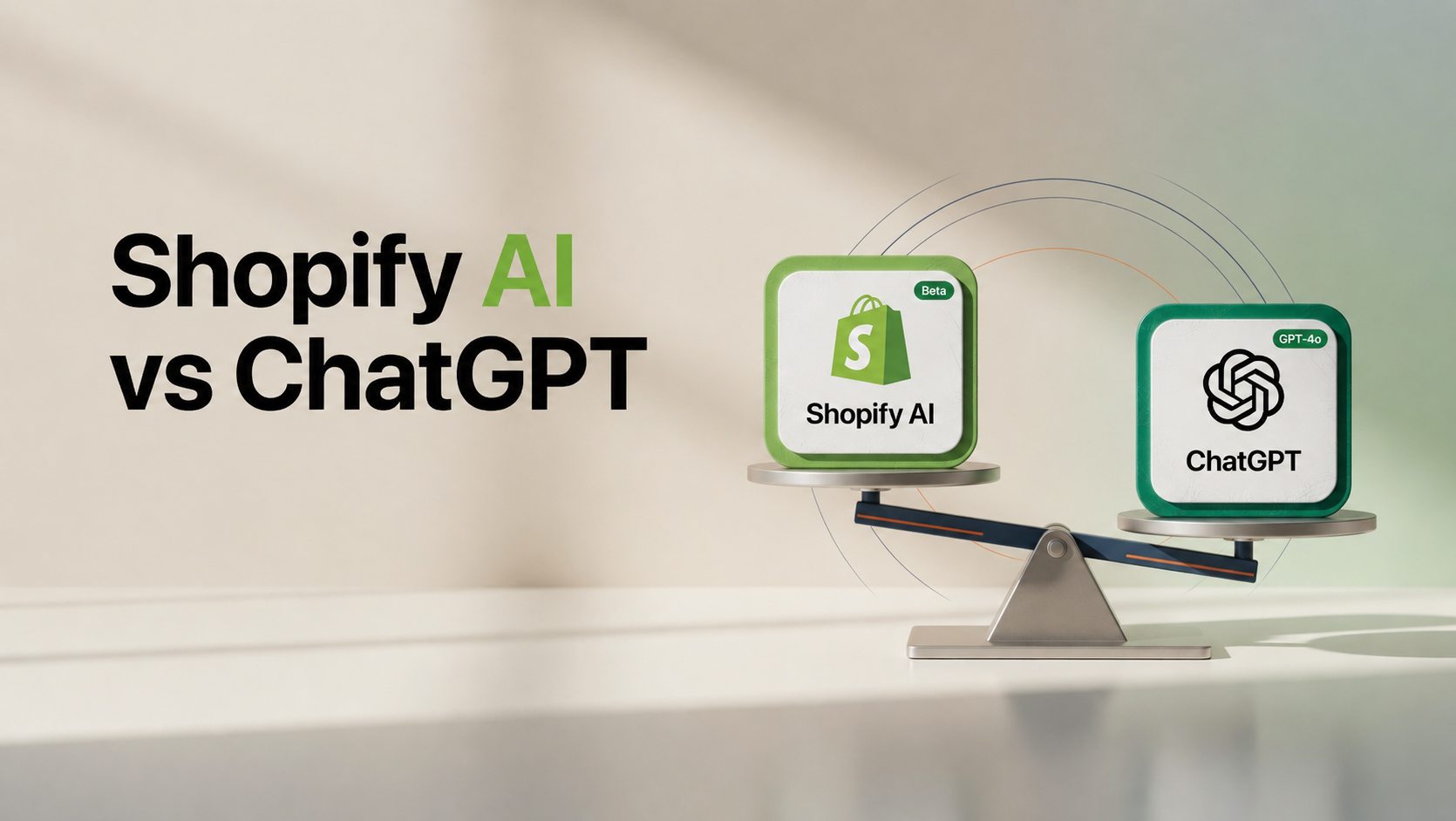
If you run a Shopify store in 2026, you’re no longer asking whether to use AI – you’re asking which AI, and how. The market has split into two distinct camps: Shopify’s native AI ecosystem (Magic + Sidekick) and the external power of ChatGPT Shopify integrations. Both promise productivity. Both deliver real results. But they solve different problems, and confusing them is costing merchants time, money, and search visibility.
This guide cuts through the noise. Whether you’re scaling a DTC brand, running an enterprise catalogue, or trying to dominate AI-powered search results through Generative Engine Optimization for Shopify, here’s exactly what you need to know in 2026.
What Is Shopify AI in 2026? Magic, Sidekick, and Agentic Storefronts Explained
Shopify Magic: Built-In Generative Commerce
Shopify Magic is the suite of AI features embedded directly into the Shopify admin. As of 2026, it covers:
- Bulk product description generation – write or rewrite hundreds of listings from a single prompt
- AI-generated email subject lines – inside Shopify Email with predicted open-rate scoring
- Image background removal and generation – native to the media editor
- Automated FAQ generation – pulled from your product data and store policies
- Smart suggested replies – inside Shopify Inbox for customer support tickets
Magic runs on Shopify’s own infrastructure, trained on commerce-specific data. It doesn’t require third-party accounts or API keys. It just works inside your dashboard.
Shopify Sidekick: The Agentic Commerce Assistant
Sidekick is Shopify’s conversational AI agent – think of it as an always-on operations co-pilot. Launched in limited beta in late 2023 and rolled out broadly through 2024–2025, Sidekick in 2026 handles:
- Natural language store configuration (“Create a 15% discount for all sneakers this weekend”)
- Real-time performance insights (“Why did my conversion rate drop yesterday?”)
- Guided workflow execution – it doesn’t just advise, it acts
- Customer segment creation and campaign triggers
- Inventory and order anomaly flagging
Sidekick represents the shift toward agentic storefronts – stores where AI takes autonomous, goal-directed actions based on business context, not just chat prompts. This is the future Shopify is building toward, and merchants who adopt it early are building a compounding operational advantage.
What Is ChatGPT for Shopify? Integration, Use Cases, and Real Capabilities
ChatGPT Shopify Integration: How It Works in Practice
ChatGPT doesn’t have a native Shopify plugin in the traditional sense. Integration happens through:
- OpenAI API + custom Shopify apps – developers pipe product data, order history, or customer queries into GPT-4o or GPT-4.1 (current flagship as of mid-2026)
- Zapier / Make automation bridges – no-code connections that trigger ChatGPT responses based on Shopify events
- Third-party apps on the Shopify App Store – tools like Tidio AI, Gobot, and several newer entrants use OpenAI models under the hood for AI shopping assistants and customer support
- Direct API implementation – for merchants with development resources, this unlocks the most flexibility: custom AI shopping assistant flows, ChatGPT-powered Shopify customer support bots, and dynamic content engines
Bulk Generate Shopify Product Descriptions with ChatGPT
One of the highest-ROI use cases in 2026 remains using ChatGPT to bulk generate Shopify product descriptions. Here’s how enterprise catalogues do it effectively:
- Export product data as CSV (title, category, attributes, material, dimensions)
- Feed structured prompts to GPT-4.1 via API with your brand voice guidelines as a system prompt
- Receive SEO-optimized, NLP-rich descriptions at scale – hundreds in minutes
- Import back via Shopify’s bulk product edit or a custom app
The output quality gap between a raw ChatGPT prompt and a well-engineered system prompt is enormous. Brands working with AI content specialists – like the team at Artzen.io – consistently outperform competitors using generic ChatGPT outputs because the prompting, brand alignment, and semantic SEO structuring are done right from the start.
Shopify Magic vs ChatGPT: Direct Comparison Table
| Feature | Shopify Magic | ChatGPT (via API/Apps) |
| Setup complexity | Zero – native to admin | Low to High (depends on method) |
| Product description generation | Yes – basic to intermediate | Yes – advanced with custom prompts |
| Bulk content generation | Yes (built-in) | Yes (API/CSV workflow) |
| Brand voice customization | Limited | Deep (system prompts) |
| Customer support AI | Shopify Inbox replies | Full chatbot deployment possible |
| SEO/NLP optimization | Basic | Advanced (with proper prompting) |
| Multimodal inputs (images) | Yes (image tools) | Yes (GPT-4o vision) |
| Agentic task execution | Via Sidekick | Requires custom development |
| Cost | Included in Shopify plan | API usage costs apply |
| GEO optimization capability | Minimal | High (when structured correctly) |
| Third-party integration | Limited | Broad |
| Data privacy | Shopify-controlled | OpenAI terms apply |
Shopify Sidekick vs ChatGPT: The Operational Intelligence Battle
What Sidekick Does That ChatGPT Can’t (Out of the Box)
Sidekick has privileged access to your live Shopify data – real-time sales, inventory, customer segments, and order pipelines. It doesn’t just respond to questions; it executes within your store environment.
Ask Sidekick: “Show me all customers who bought running shoes but haven’t ordered in 90 days and create a win-back segment.”
It does it. Inside your admin. Immediately.
ChatGPT, without custom Shopify API integration, is working blind. It can help you plan that campaign strategy, but it can’t touch your store data unless your development team has built that bridge.
What ChatGPT Does Better for Shopify Merchants
ChatGPT wins when the task is creative, strategic, or content-heavy:
- Long-form brand storytelling and editorial content
- Advanced prompt engineering for scalable product copy
- Customer persona development and market research synthesis
- Competitor analysis frameworks
- Email sequence architecture
- Technical SEO strategy and schema markup planning
For merchants without a dedicated content team, combining both tools is the highest-leverage move: Sidekick handles ops, ChatGPT handles content and strategy.
AI SEO for Shopify in 2026: The GEO Layer Competitors Are Missing
Here’s what almost no competitor article mentions: the SEO game for Shopify stores has fundamentally changed, and most merchants haven’t adapted.
In 2026, your content needs to rank in:
- Google’s traditional SERPs
- Google AI Overviews (formerly SGE)
- ChatGPT’s browsing responses
- Perplexity AI results
- Gemini’s shopping integrations
This is Generative Engine Optimization (GEO) – and it requires a different structure than classic Shopify SEO.
GEO Optimization Checklist for Shopify Stores
For AI Overviews and LLM visibility:
- Answer questions directly in the first 40–60 words of any page
- Use FAQ schema on product and collection pages
- Structure content with clear H2/H3 hierarchies and concise definitions
- Build topical authority clusters – not just individual optimized pages
- Earn citations from trusted industry sources (Google, Shopify official docs, Statista)
For product pages specifically:
- Include semantic entity signals: brand, material, use case, target audience, comparison terms
- Add structured data: Product, Review, Offer, and BreadcrumbList schema
- Answer the “best for” and “compared to” queries on-page
For category and collection pages:
- Write 300–500 words of expert-authored, entity-rich context above or below the product grid
- Include natural internal links to educational content and buying guides
Merchants who want a done-for-you GEO and AI SEO strategy for their Shopify store – including technical schema implementation, topical cluster mapping, and AI-optimized copywriting should explore what the specialists at Artzen.io offer. Their work sits at the intersection of AI, SEO, and conversion-focused brand design in a way that generic SEO agencies aren’t equipped to deliver in 2026.
AI Shopping Assistant for Shopify: Building a ChatGPT-Powered Customer Experience
An AI shopping assistant built on ChatGPT can handle:
- Real-time product recommendations based on conversational inputs (“I need a gift for a 40-year-old who loves trail running, budget under $150”)
- Size and compatibility guidance
- Order status lookups (via API integration)
- Return policy clarification
- Post-purchase upsell sequences
The key to making this work is retrieval-augmented generation (RAG): your product catalogue, FAQs, and policy documents are embedded and retrieved dynamically to ground the AI’s responses in your actual inventory – eliminating hallucinations and keeping answers accurate.
Several Shopify App Store solutions now offer pre-built RAG pipelines. For custom implementations with brand-specific logic, the integration work typically runs 40–120 hours of development. The ROI, however, is compelling: AI-assisted shopping sessions consistently show higher average order values compared to unassisted browse sessions, driven by confident, personalized recommendations.
Shopify ChatGPT Customer Support: What’s Working in 2026
Automating Tier 1 support (order status, return windows, size guides, product availability) with a ChatGPT-powered bot reduces ticket volume substantially. The critical success factors:
- Human escalation paths – always offer a live agent option; AI-only walls destroy trust
- Tone calibration – your support bot should sound like your brand, not a generic assistant
- Live inventory sync – responses must reflect current stock, not cached data
- GDPR/privacy compliance – especially for EU markets; confirm your integration handles data correctly
Frequently Asked Questions
Is Shopify Magic free?
Shopify Magic is included in all Shopify plans at no additional cost. Some advanced features may have usage limits depending on your plan tier. There are no additional API costs for using Magic natively inside the Shopify admin.
Can I use ChatGPT to write product descriptions for Shopify?
Yes – and at scale. With the OpenAI API or a third-party Shopify app, you can bulk-generate product descriptions from structured product data. For best results, use a carefully crafted system prompt that encodes your brand voice, target audience, and SEO requirements. Raw ChatGPT outputs without proper prompting tend to be generic and underperform in search.
What is the difference between Shopify Sidekick and ChatGPT?
Shopify Sidekick has live access to your store data and can execute tasks inside your Shopify admin. ChatGPT is a general-purpose AI that requires custom integration to interact with Shopify data. Sidekick wins on operational execution; ChatGPT wins on creative and strategic tasks requiring depth and flexibility.
What is Generative Engine Optimization (GEO) for Shopify?
GEO is the practice of structuring your Shopify content so it ranks inside AI-generated answers – including Google AI Overviews, ChatGPT’s browsing results, Perplexity, and Gemini. It involves question-forward content structures, robust schema markup, topical authority building, and entity optimization – going beyond traditional keyword SEO.
Can Shopify AI replace a human copywriter?
No – and in 2026, the gap is visible in conversion data. AI tools dramatically accelerate content production and handle scale that no human team can match. But brand voice calibration, strategic storytelling, emotional resonance, and GEO-specific structuring still require expert human judgment. The highest-performing Shopify brands use AI as an accelerant, not a replacement.
Which is better for Shopify SEO – Shopify Magic or ChatGPT?
For basic product descriptions on a lean budget, Shopify Magic is a fast starting point. For serious AI SEO for Shopify – including NLP entity optimization, GEO-structured content, bulk catalogue optimization, and ranking in AI search engines – a properly engineered ChatGPT workflow (or a specialist like Artzen.io) delivers meaningfully better results.
The Verdict: Shopify AI vs ChatGPT – Use Both, Strategically
Neither tool wins outright. The merchants pulling ahead in 2026 aren’t choosing between Shopify AI and ChatGPT – they’re deploying both in a layered strategy:
- Shopify Magic for fast, zero-friction content tasks inside the admin
- Shopify Sidekick for agentic store management and real-time operational decisions
- ChatGPT (via API or apps) for advanced content production, customer-facing AI experiences, and GEO-optimized copywriting at scale
The critical edge – the one most Shopify merchants are missing – is the GEO layer. Ranking in Google AI Overviews, Perplexity, and ChatGPT responses in 2026 requires content architecture most stores don’t have. That’s where structured AI SEO strategy, schema implementation, and topical authority building become the real competitive moat.
If you’re serious about building that moat for your Shopify store, the team at Artzen.io specializes in exactly this intersection: AI-powered content, Generative Engine Optimization, Shopify SEO, and brand-driven web development for ambitious ecommerce brands.
Artzen is a performance-driven agency specializing in ecommerce SEO services in India. Backed by years of industry experience and a team of certified, highly skilled SEO specialists, we implement strategies with precision and measurable growth. We prioritize our clients at every stage, delivering results that exceed customer expectations.