06 Mar
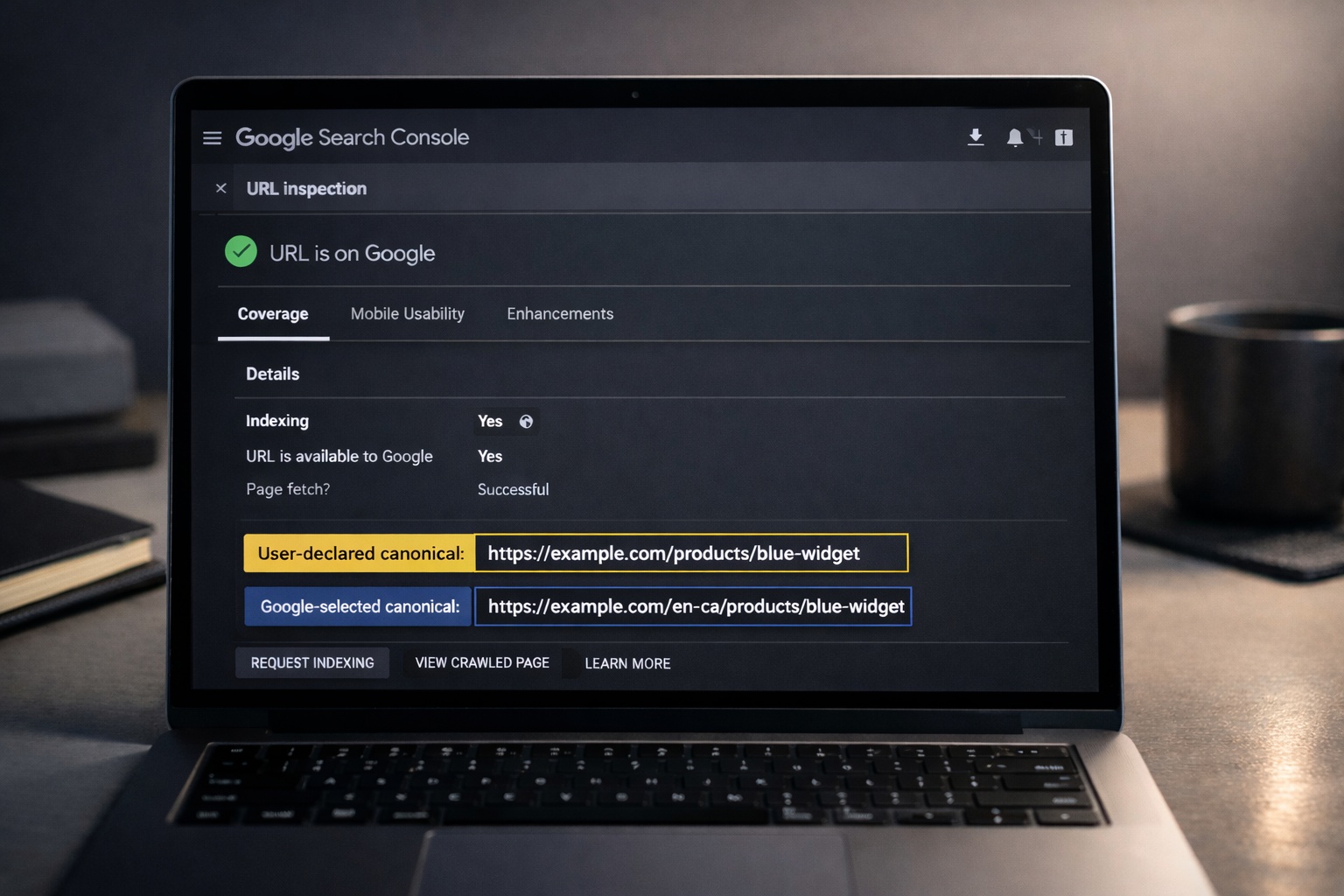
Shopify Markets duplicate content can sneak up on you after you add new countries, languages, subfolders, or multiple domains. The result often looks like this in Google Search Console (GSC): “Google chose different canonical than user”, unexpected indexation of “wrong” locale URLs, or pages competing against each other.
In this guide, you’ll learn why it happens, how canonicals and hreflang should work together, and how to fix Shopify canonical tags (often without an app) so Google indexes the right pages in the right country.
Why Shopify Markets duplicate content happens
Shopify Markets is built to publish localized storefronts fast. However, international setups create more URLs for the same core content, and that’s where duplication starts.
Common causes include:
- Multiple domains for the same content (example.com and example.ca showing near-identical pages)
- Subfolder duplication (example.com/en-us/ and example.com/ both accessible)
- URL parameters like ?currency=USD, ?variant=…, or tracking parameters
- Collection-aware URLs (a product reachable via multiple paths)
- Theme-level canonical overrides that output the wrong canonical URL
- Misaligned hreflang + canonical signals, especially across domains
As Google explains, canonicalization is how it picks a preferred URL when duplicates exist, and Google may choose a different canonical if your signals conflict or look inconsistent. See Google’s canonical guidance:
https://developers.google.com/search/docs/crawling-indexing/consolidate-duplicate-urls
Shopify hreflang vs canonical
This is the part many stores miss.
Canonicalization tells Google “index this one”
A canonical tag should generally point to the preferred version of the same content. On international sites, that usually means each locale URL uses a self-referencing canonical (unless you intentionally consolidate).
Hreflang attributes tell Google “show this to these users”
hreflang connects equivalent pages by language/region so Google can serve the right version in search results. Google’s hreflang docs are here:
https://developers.google.com/search/docs/specialty/international/localized-versions
The key rule: don’t make them contradict each other
If your en-us page canonicals to the root /en/ (or to another domain), but your hreflang says en-us is a valid alternate, Google gets mixed signals. Therefore, you may see:
- Shopify Markets duplicate content en-us issue
- GSC showing “Google chose different canonical than user Shopify”
- Locale pages dropping from the index
How to confirm duplicate content in GSC
First, confirm what Google is doing before you change code.
1) Use the URL Inspection tool
Check a problematic localized URL and look at:
- User-declared canonical
- Google-selected canonical
- Indexing status
- Crawled as (Googlebot smartphone is typical)
If Google keeps selecting a different canonical, you likely have either weak internal linking signals, conflicting canonicals, or duplicate accessibility across domains/subfolders.
2) Check the Pages report
In GSC, open Indexing → Pages and review common international patterns:
- “Duplicate, Google chose different canonical than user”
- “Duplicate without user-selected canonical”
- “Alternate page with proper canonical tag”
3) Spot URL patterns that create duplicates
Next, export affected URLs and look for patterns:
- /products/product vs /collections/collection/products/product
- ?currency= or ?country= parameter URLs
- locale subfolders that mirror root content
This is the fastest way to pinpoint whether you have a Shopify subfolder duplicate content problem, a multiple domains SEO problem, or both.
Fix Shopify canonical tags often without an app
Many Shopify canonical problems come from themes. In a lot of cases, you can fix Shopify canonical tags without app installs.
Confirm you’re using Shopify’s canonical URL output
In your theme’s theme.liquid file, you want a canonical tag that relies on Shopify’s canonical URL value, not a hand-built URL.
Recommended canonical tag (Liquid theme templates):
liquid
<link rel=”canonical” href=”{{ canonical_url }}”>
Shopify’s Liquid docs (including canonical-related objects) live on Shopify.dev:
https://shopify.dev/docs/api/liquid
Red flags that cause “canonical tag pointing to wrong URL”
Replace or remove canonicals that are built from request paths, like:
- using {{ request.path }} to form canonicals
- hardcoding the primary domain while serving multiple domains
- adding locale logic that forces everything to one market
Those patterns often trigger Shopify Markets canonical issues because they can output a canonical that doesn’t match the actual localized URL.
Fix collection-aware URLs
A product can be reached at:
- /products/widget
- /collections/sale/products/widget
That second URL is a classic duplicate. The canonical should normally point to the clean product URL. Therefore:
- avoid internal links that overuse collection-aware product URLs
- ensure your canonical tag doesn’t accidentally “lock onto” the collection path
If your theme builds product links with collection context everywhere, you create inconsistent signals at scale.
Clean up parameter duplicates
If you see indexation for URLs with parameters, tighten signals:
- make sure the canonical points to the clean URL
- keep internal links clean (don’t link to parameterized URLs)
- use GSC’s URL Parameters handling only when appropriate (Google often ignores heavy-handed settings)
Shopify Markets SEO settings: hreflang and international best practices
Shopify Markets can automatically output hreflang in many setups. Still, you need to validate it.
Validate hreflang clusters
Each localized page should reference:
- itself
- all alternates
- an optional x-default when appropriate
Also, confirm language-region codes match reality (for example, en-US vs en-us). Small formatting issues can cause Shopify Markets hreflang error GSC messages.
Localized content matters more than structure
If every market is a copy-paste with only currency changes, Google may treat alternates as near-duplicates. In addition, you risk weak performance in local SERPs.
To reduce Shopify international SEO issues:
- localize titles, meta descriptions, and on-page copy
- localize shipping/returns pages
- add market-specific FAQs and trust signals
- use localized internal linking (blog content per market when it’s justified)
Shopify Markets subfolder vs subdomain SEO vs multiple domains
Structure affects how authority and duplication behave.
Subfolders often easiest for consolidation
Example: example.com/en-us/ and example.com/en-ca/
Pros:
- link equity stays concentrated on one host
- simpler crawling and analytics
Watch-outs:
- duplication if root pages still serve the same content as a locale
- internal linking must be consistent
Subdomains
Example: us.example.com
Pros:
- cleaner separation if teams and catalogs differ
Watch-outs:
- subdomains can behave like separate properties for SEO signals
- extra overhead for tracking, crawl management, and content parity
Multiple domains common with Markets
Example: example.com and example.ca
Pros:
- strong country targeting and branding
- often best for legal and payments differences
Watch-outs:
- cross-domain canonicals must be handled carefully
- hreflang must be perfect
- internal links should respect the user’s market to prevent constant cross-domain duplication
If you’re unsure which structure best fits your store, an expert-led audit usually pays for itself. You can request a focused Shopify SEO audit for duplicate content at artzen.io: https://artzen.io
Crawl buget optimization + indexation cleanup checklist
Once you fix canonicals and hreflang, tighten the site so Google wastes less time crawling duplicates.
Use this checklist:
- Keep one clean internal link path per page (avoid mixed locale linking)
- Ensure redirects don’t bounce users across markets unnecessarily
- Block or reduce crawlable duplicates from:
- internal search pages
- filter/sort URL parameter combinations (when they create crawl traps)
- Re-submit key sitemaps and re-check indexing after changes
- Re-audit GSC Coverage / Pages report in 2–4 weeks
When you align canonicals, hreflang attributes, internal linking, and crawl paths, Shopify Markets duplicate content usually drops sharply.
Conclusion
Shopify Markets duplicate content is fixable once you line up the signals Google trusts. First, confirm the problem in Search Console by checking the user-declared and Google-selected canonical. Next, make sure your theme outputs a clean, consistent canonical URL, and reduce duplicates from collection-aware links and parameter URLs. After that, validate that hreflang points to real localized pages and does not conflict with your canonicals across subfolders or multiple domains. Finally, improve localization so each market has unique value, not just currency swaps. Done right, your pages consolidate authority and index cleanly.
FAQ
Does Shopify Markets cause duplicate content?
Yes, Shopify Markets can cause duplicate content if not configured correctly. When you create localized subfolders (like /en-ca/), Google sees identical products across multiple URLs. You must use proper hreflang tags and self-referencing canonicals to prevent ranking drops.
How do I fix the Google chose different canonical than user error on Shopify?
This error occurs when your internal links point to a different URL than your canonical tag. To fix it, ensure your navigation menus, footer links, and sitemaps point strictly to your intended canonical URLs. Remove any redirects causing mixed signals.
Should I use subfolders or subdomains for Shopify Markets SEO?
You should use subfolders for Shopify Markets SEO. Subfolders (like yourstore.com/en-ca/) share link equity and domain authority with your primary website. Subdomains act as separate websites, forcing you to build SEO authority entirely from scratch.
How do I fix collection-aware URLs on Shopify?
Collection-aware URLs create massive duplicate content issues. To fix this, edit your theme’s product grid Liquid files. Remove the | within: collection filter from the product links. This ensures all internal links point directly to the clean, root product URL.
How do I check for Shopify canonical tag issues?
You can check for Shopify canonical tag issues using the Google Search Console Pages report. Look under the “Alternate page with proper canonical tag” and “Duplicate without user-selected canonical” sections. You can also use crawling tools to flag missing or conflicting tags.