15 May
What You Need to Know First
- Launch date: OpenAI began testing advertisements in ChatGPT on February 9, 2026.
- Who sees ads: Logged-in adult users on the Free and Go subscription tiers in the United States. Expansion to Canada, Australia, and New Zealand is now underway.
- Who does not see ads: Users on Plus ($20/month), Pro ($200/month), Team, Business, Enterprise, and Education accounts do not see ads.
- Pricing model: CPM-based at launch, with CPC bidding now available. CPMs launched at $60 and have since dropped.
- Advertiser access: A beta version of the self-serve Ads Manager began rolling out to advertisers in the U.S. in May 2026.
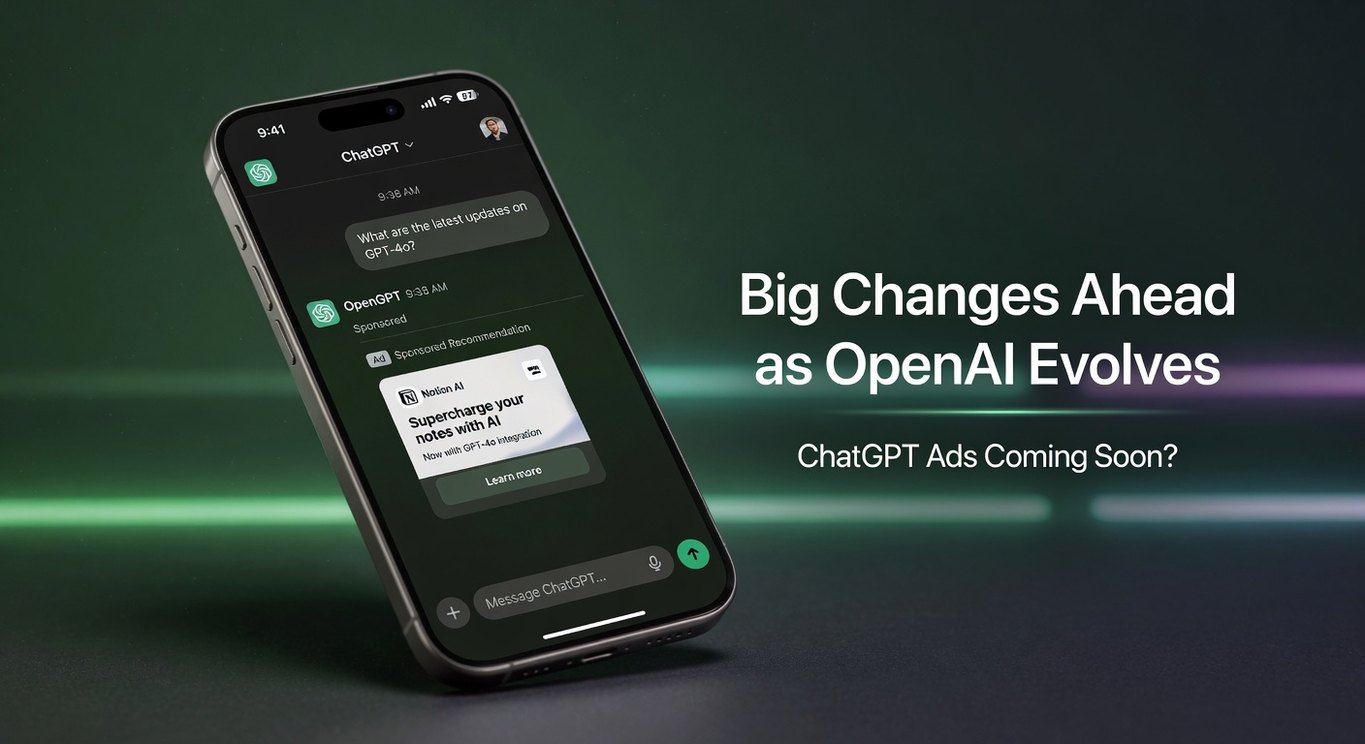
- Ad format: A single “chat_card” format is a sponsored card appearing below the AI response, clearly labeled as sponsored.
- Major restrictions: Ads are blocked from appearing near health, mental health, politics, gambling, legal services, and financial services content.
The Backstory: How ChatGPT Got Into Advertising
It did not happen overnight, and it did not happen quietly.
The move reversed years of public skepticism from CEO Sam Altman, who had called advertising a “last resort.” The financial reality of burning through billions while only 5% of 800 million weekly users pay for subscriptions made the decision inevitable.
OpenAI had previously discussed an ads model as early as December 2024, when CFO Sarah Friar publicly raised advertising as a potential revenue lever. In December 2025, OpenAI denied live ChatGPT ad tests as promoted content began surfacing for some users. Within days, OpenAI disabled app suggestions after backlash from users who found the feature intrusive and opaque. February 2026’s rollout arrived roughly ten weeks later, formalized as a named beta with stated guardrails.
That sequence matters for advertisers trying to understand how seriously OpenAI has approached the rollout. The high entry thresholds and brand-safety exclusions at launch were not arbitrary. They reflected lessons the company absorbed from the December backlash.
Who Actually Sees ChatGPT Ads
This is one of the most commonly misunderstood aspects of the platform, and getting it wrong will distort any reach estimates you build.
The advertising rollout affects users on ChatGPT’s Free and Go subscription tiers. Higher-tier subscriptions including Plus ($20/month), Pro ($200/month), Business, Enterprise, and Education accounts remain ad-free.
OpenAI will not show ads in accounts where the user tells them or they predict the user is under 18.
OpenAI also offers eligible users an “Ads-Free” option on the Free tier in exchange for lower usage limits, which trims available impressions further. A company spokesperson told reporters earlier this year that fewer than 20% of eligible users were being shown ads daily during the pilot.
So while ChatGPT’s aggregate user numbers look enormous, the addressable ad audience is considerably smaller. Advertisers planning reach projections need to account for all of these filters before relying on raw platform size figures.
What the Ad Format Actually Looks Like
The single ad format documented today is called a “chat_card.” It carries a 3–50 character title, up to 100 characters of body copy, an image, a favicon, and a target URL. There is no publicly documented self-serve video, carousel, or interactive format yet, although OpenAI has signalled that more formats will follow.
Ads appear at the bottom of AI-generated responses in subtly tinted boxes that visually distinguish sponsored content from organic answers. Each ad includes clear “sponsored” labeling, ensuring users immediately recognize promotional material.
One critical fact that surprised many advertisers when it first emerged: ads do not wait for extended conversations before appearing. Early speculation suggested advertisements would surface only after extended conversations. Reality proved different. When a user asked “What’s the best way to book a weekend away?”sponsored placements appeared immediately with the first response.
Based on Adthena’s analysis of over 1,500 prompts, most ads surface on the first prompt in a session. Keywords like “best” and “new” are driving commercial intent. Simple prompts like “I need a new phone” and “What’s the best desk?” are enough to trigger ads.
The mechanism is closer to commercial intent matching than deep conversational analysis. At this stage, the system is reacting to strong purchase-intent signals in the query itself rather than analyzing the emotional tone or depth of a conversation.
How ChatGPT Ad Targeting Works
ChatGPT’s targeting model differs from both search and social advertising. Advertisers do not buy keywords in the traditional sense, and they do not receive access to user conversation transcripts.
OpenAI decides which ad to show by matching ads submitted by advertisers with the topic of the conversation, the user’s past chats, and their past interactions with ads.
For now, the live system is operating on a more direct version of intent matching. Category-level targeting and conversation topic relevance are the primary levers available to advertisers in the current build.
ChatGPT Advertising Costs: The Full Pricing Picture
Pricing has moved significantly since launch, and any article citing only the original figures is already out of date.
At launch (February 9, 2026): OpenAI set a cost per mille (CPM) of approximately $60 per 1,000 impressions and required advertisers to commit a minimum of $200,000 to participate in the beta program.
By late April 2026: The rate advertisers pay to reach every thousand users has fallen from $60 at launch nine weeks ago to as low as $25 and counting. Ad agency Jellyfish’s chief of media activation said that while the $60 base rate holds, he’s seeing averages closer to $45 depending on inventory composition. One ad exec said on condition of anonymity that they’ve been seeing CPMs range between $35 and $25 in recent days when buying ads via Criteo.
Minimum spend threshold: The minimum spend required to participate has fallen from $250,000 at launch to $50,000, widening the pool of advertisers.
As of May 5, 2026: On May 5, 2026, OpenAI simultaneously opened its self-serve Ads Manager to all US businesses, dropped the minimum spend threshold entirely, and introduced cost-per-click bidding alongside its existing CPM model.
CPC pricing: Digiday reports that an early version of ChatGPT’s ads manager, available to a subset of pilot advertisers, now shows cost-per-click bids ranging from $3 to $5, based on screenshots reviewed and verified by the publication.
Context for these rates: Facebook averages $4.82 CPM, Instagram $7.63, Google Display $10.33, and TikTok $3.02, according to Gupta Media. The more instructive comparison may be LinkedIn currently $39.19 which advertisers have long accepted as expensive because the context justifies it.
OpenAI’s internal argument for the premium is straightforward: a user encountering an ad in ChatGPT is already in an active decision-making state, closer to a high-intent search query than passive social browsing. Whether that argument holds at scale as inventory grows is still being tested.
How to Get Access to ChatGPT Advertising in May 2026
The access pathway has changed dramatically from the invite-only enterprise model at launch.
Option 1: Self-serve Ads Manager (newest)
Businesses can register as advertisers on the platform to launch and manage their campaigns in real time through ChatGPT. The Ads Manager will also be available to several ad tech companies such as Adobe, Criteo, Kargo, Pacvue, and StackAdapt. As of May 5, 2026, there is no minimum spend threshold for US businesses using the self-serve platform.
Option 2: Agency partners
Advertisers can create ads through the tool directly or through agency partners such as Dentsu, Omnicom, Publicis, and WPP. This route suits brands that prefer managed service over self-directed campaign management.
Option 3: Ad tech partners
Criteo was the first technology partner to be formally identified, on March 2, 2026, connecting approximately 17,000 advertiser clients to ChatGPT’s Free and Go tiers. By May 5, 2026, Criteo reported over 1,000 brands running active campaigns through its API connection. StackAdapt joined on May 5, 2026, making programmatic access to ChatGPT placements available for the first time.
Timeline of access milestones:
February 9, 2026: ChatGPT officially began serving ads. February 20, 2026: First publicly verified ad sightings; confirmed advertisers included Expedia, Qualcomm, Best Buy, Enterprise Mobility, and The Knot Worldwide. March 2, 2026: Criteo announced as first ad tech partner. March 11, 2026: OpenAI began testing Ads Manager dashboard with a small group of partners. March 26, 2026: ChatGPT advertising crossed $100 million in annualized revenue; OpenAI announced expansion to Canada, Australia, and New Zealand.
Who Is Already Running Ads
WPP, Omnicom, and Dentsu all signed on as launch partners, bringing brands like Adobe, Ford, Mazda, Audible, and Audemars Piguet into early experiments. Target’s retail media business, Roundel, was among the first to test.
The roster of confirmed advertisers has grown in two identifiable waves, tracked by Adthena. What connects most of the early advertisers is their category: retail, consumer electronics, automotive, travel, and home goods. These are all verticals where users routinely ask high-intent questions.
One particularly telling data point: in Adthena’s research, Best Buy secured two separate ad placements in a single ChatGPT response to an iPhone-related query early experimentation with share of voice within a single AI conversation, a concept that does not have an equivalent in traditional search advertising.
Restrictions and Disallowed Categories
This is where many advertiser evaluations stall. The restriction list is extensive and actively enforced.
Permanently restricted content areas (from OpenAI’s official ad policies): All other categories are disallowed at launch, including ads related to sensitive or regulated areas such as dating or sexual content, health claims, alcohol and drugs, healthcare, financial or legal services, gambling, and political content.
Restricted conversation contexts: OpenAI bars ads from sensitive conversation contexts entirely, including child safety, self-harm, hate, weapons, terrorism, mental health, emotionally reliant interactions, and politics, which puts a real ceiling on inventory in a way feed-based platforms don’t have.
Healthcare specifics: Ads for regulated medical products, services, or claims involving the prevention, diagnosis, or treatment of physical or mental health conditions are currently disallowed. This includes prescription drugs, clinical care providers, hospitals, prescription services, and over-the-counter medications. General health and wellness products that do not make medical claims may be permitted, such as fitness equipment, wearable devices, or menstrual products.I
Policy update from April 2026: Medical, legal, and financial advice contexts are no longer categorically blocked from ads by default. Sensitive conversations and other prohibited contexts remain ineligible for ads. This is a nuanced shift. It means permitted ad categories can now appear in conversations that touch on these general topics, but ad content itself promoting medical, legal, or financial services remains restricted.
The policy document was updated in April 2026 and will continue to evolve. Advertiser eligibility should be treated as a moving target.
Measurement and Tracking: The Real Limitation
This is the issue practitioners raise most frequently, and it is the one where ChatGPT advertising is furthest behind established platforms.
What is now available: OpenAI launched two critical measurement tools in May 2026: a Conversions API and pixel-based tracking, providing advertisers with the attribution infrastructure necessary for serious campaign investment. These tools enable tracking of post-click behaviors including landing page views, product catalog views, add-to-cart events, and completed purchases.
What the CTR data shows: Click-through rates sit at 0.91%, roughly seven times below Google Search’s 6.4% benchmark.
The measurement credibility problem: “Google and Meta own industry measurement, and that’s the real moat, not the UI,” said Robert Webster, founder of AI marketing consultancy TAU. “Post-click is easy. Post-view at $60 CPM is hard. Until someone independent can verify what a ChatGPT impression is actually worth, advertisers are taking OpenAI’s word for it.”
The Conversions API and pixel tools represent a meaningful improvement over the brand-exposure-only model from launch. But third-party, independent verification of ChatGPT impression quality does not yet exist at the scale that Google and Meta have built over years. Performance marketers used to rigorous attribution should plan for proxy measurement in early campaigns.
What OpenAI Says Ads Cannot Do
These are verified commitments from OpenAI’s official policies, not marketing claims.
Ads do not influence the answers ChatGPT gives. Answers are optimized based on what’s most helpful to the user. Conversations with ChatGPT remain private from advertisers.
Ads “do not influence the core organic model” of ChatGPT, and OpenAI holds a high bar on user privacy.
Users also have meaningful controls. Users can control the ads they see in ChatGPT, including dismissing ads, sharing feedback, learning how and why they’re being shown a particular ad, deleting their ad data with one tap, and managing ad personalization at any time.
Real Advertiser Concerns You Should Know About
These are legitimate issues being discussed across industry publications and forums not abstract risks.
Inventory is narrower than the headline user numbers suggest. The combination of paid-tier exclusions, the under-18 block, the opt-out option, and the sensitive-topic restrictions means the actual daily addressable audience is a fraction of ChatGPT’s total user base. Fewer than 20% of eligible users were being shown ads daily during the pilot.
Pricing remains elevated compared to performance data. ChatGPT ads face performance challenges, including lower click-through rates and higher pricing. At even the current range of $25–$45 CPM, advertisers are paying significantly above most social inventory for a platform with a 0.91% CTR.
Attribution is still early. The Conversions API and pixel tools launched in May 2026 are the first serious infrastructure for performance tracking. Prior to this, advertisers were effectively measuring visibility, not outcomes.
Self-serve tooling is new. The Ads Manager is described by those who have tested it as broadly similar in layout to Google Ads serviceable, functional, and clearly built for speed rather than sophistication. It is not a mature, feature-rich interface yet.
Category restrictions significantly limit who can actually advertise. Healthcare, finance, legal, gambling, alcohol, and dating brands are largely excluded at this stage. The available categories lean heavily toward retail, consumer goods, travel, and lifestyle.
Are ChatGPT Ads Worth Testing in 2026?
Fact: opinion follows. The research supports a nuanced assessment rather than a simple yes or no.
The case for testing: ChatGPT users exhibiting commercial intent in conversation represent a genuinely high-intent audience. Internal Criteo data showed AI-referred conversion rates approaching twice those of traditional search in categories including consumer electronics, lifestyle, and home and garden though that data comes from Criteo’s own client base and has not been independently verified. The self-serve platform is now open to any US business with no minimum, and the introduction of CPC bidding makes performance comparison against Google and Meta directly possible.
The case for waiting: Measurement infrastructure is immature. CTRs are well below search benchmarks. Independent third-party verification of impression quality does not exist. The restriction list is long and still evolving, and best practices are still being formed in public.
The honest read in May 2026 is that the foundation is now real enough to plan around, but the ceiling and the rules are both still in motion.
Advertiser Qualification Checklist
Before committing any budget to ChatGPT advertising, verify the following against current platform policy:
Category eligibility
- Is your product or service in an allowed category? (Confirmed allowed: lifestyle and household goods, local services, travel and experiences, digital products, education.)
- Does your ad content make any health claims, even general wellness claims, that could require policy review?
- Do any of your landing pages include disallowed content even if the ad itself is compliant?
Audience fit
- Is your target customer likely to be on the Free or Go tier of ChatGPT rather than a paid subscriber?
- Are they in the US, Canada, Australia, or New Zealand (the current ad-eligible markets)?
- Does your product resonate with users in an active research or purchase-decision mindset?
Measurement readiness
- Do you have the Conversions API or pixel tracking configured before launch, not after?
- Have you defined what success looks like in the absence of mature independent attribution?
- Do you have a proxy measurement plan for early campaigns?
Budget and access
- Are you entering via self-serve, an agency partner, or an ad tech platform like Criteo or StackAdapt?
- Have you accounted for the intent-to-conversion gap implied by a 0.91% CTR in early data?
- Are you treating initial spend as a learning investment rather than a performance line item?
Practical Steps to Start Advertising on ChatGPT Right Now
Step 1: Visit openai.com/advertisers and register your business. The self-serve Ads Manager is now in beta rollout for US businesses as of May 5, 2026, with no minimum spend.
Step 2: If you prefer managed access, contact one of the confirmed agency partners Dentsu, Omnicom, Publicis, or WPP or work through an ad tech partner like Criteo, StackAdapt, Kargo, Pacvue, or Adobe.
Step 3: Review OpenAI’s published ad policies (openai.com/policies/ad-policies) before building creative. The policy was updated in April 2026, and creative must be consistent end-to-end with the destination page.
Step 4: Install the Conversions API and pixel tracking on your destination pages before your first campaign goes live.
Step 5: Plan for two months of data collection before drawing conclusions. The platform is new, inventory patterns are still being established, and one month of data is not sufficient for informed optimization.
Where ChatGPT Advertising Is Heading
Industry analysts project US AI-driven search advertising will grow from $1.1 billion in 2025 to $26 billion by 2029. OpenAI itself targets $25 billion in ad revenue by 2028, positioning ChatGPT advertising as a cornerstone of the company’s financial sustainability.
OpenAI is no longer testing whether ads belong inside ChatGPT. It is now building the infrastructure needed to scale them. The addition of a self-serve platform, CPC bidding, international expansion, and Conversions API in just three months since launch is a faster buildout than most established ad platforms achieved in equivalent early windows.
Voice advertising capabilities, deeper audience targeting using first-party customer list matching, and expanded ad formats are all on record as being planned for later in 2026. None of these are verified as live at the time of writing.
Disclosure: This article was written in May 2026 using verified data from OpenAI’s official policy pages, Digiday, Search Engine Journal, Adthena, Axios, PPC Land, and other primary-source reporting. To get your PPC or SEO done consult Artzen Technologies. Pricing figures and platform specifications are subject to change as OpenAI continues to develop its advertising product. Where figures come from single-source reporting, that is noted.
Artzen is a performance-driven agency specializing in ecommerce SEO services in India. Backed by years of industry experience and a team of certified, highly skilled SEO specialists, we implement strategies with precision and measurable growth. We prioritize our clients at every stage, delivering results that exceed customer expectations.