18 Feb
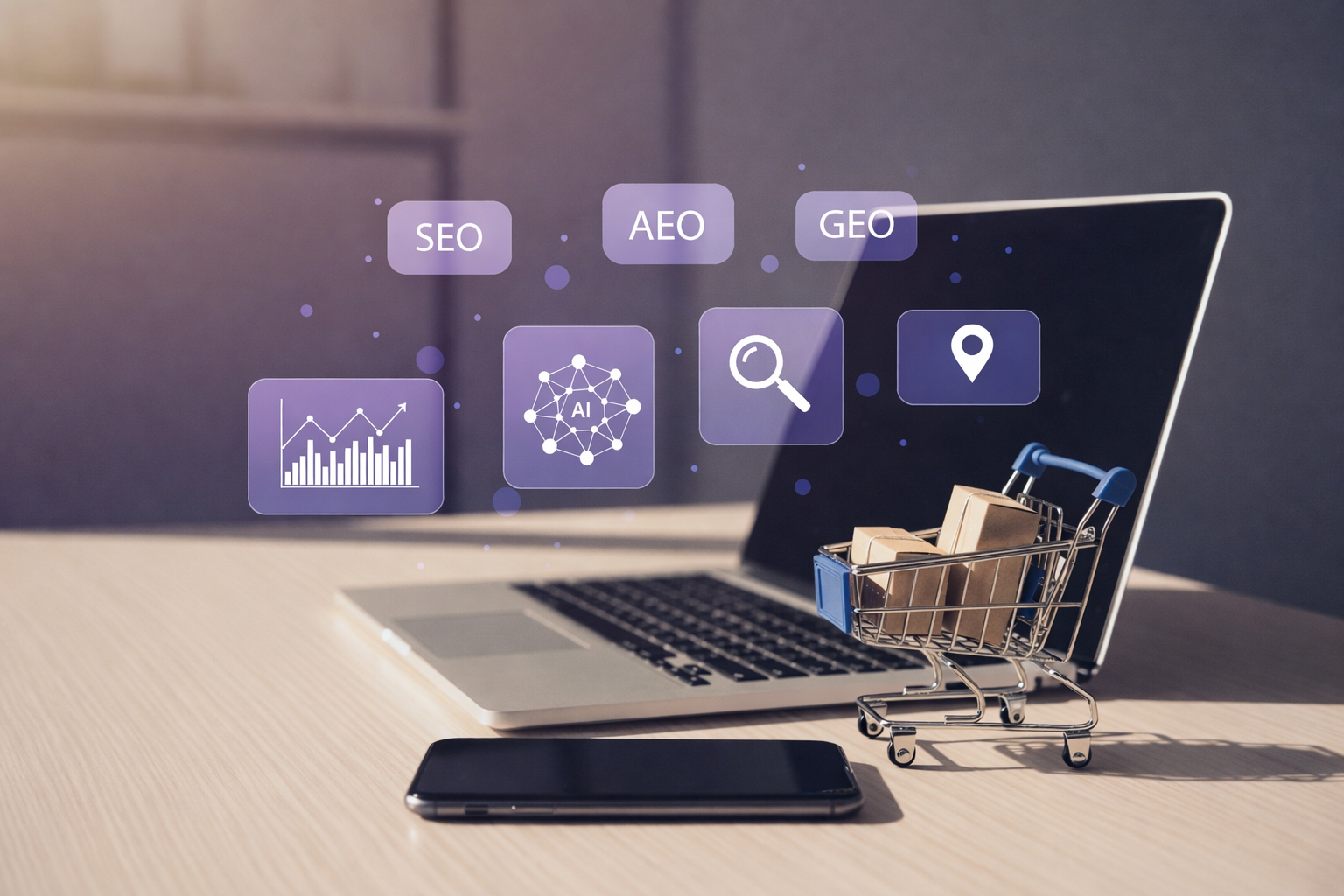
Google is continually pushing organic results down in searches by adding more advanced SERP features such as People Also Ask, ads, instant answers, and AI Overviews. But even that’s no longer enough. To hit the top spot for your blog or target keyword in 2026, you are no longer competing only with traditional blue links. You are competing across AEO vs GEO vs SEO, where answers, generative results, and rankings decide visibility.
This blog explains each strategy clearly and shows how to use them for growth in 2026. But first, let’s understand a few basics through a comparison table.
The table below breaks down AEO, GEO, and SEO in simple terms. So, you can see where each fits into a modern eCommerce search strategy.
AEO vs GEO vs SEO: Comparison with Examples & Resources
| Factors | AEO | GEO | SEO |
|---|---|---|---|
| Primary Goal | Display content as a direct answer | Show content referenced in AI-generated responses | Rank webpage in traditional results |
| Visibility Source | Featured snippets, People Also Ask, instant answers | Generative search responses, Google AI overviews | Organic blue links below ads and SERP features |
| Optimization Techniques | Semantic relevance, E-E-A-T, topical authority | Structured data, direct answers, FAQs | Technical SEO, On-page SEO, backlinks |
| Content Focus | Clear, concise, queries-based answers | Context-rich, entity-focused, authoritative content | Keyword-optimized, in-depth page |
| Content Formats | Definitions, how-to steps, FAQs | Expert guides, comparisons, research-backed content | Landing pages, blogs, category pages |
| Example | Answering “Which is the best running shoe?” in a snippet | Chosen as an AI citation overview for “How to choose the best running shoes” | Rank for “best running shoes” through an article or blog post |
| Helpful Resources | Featured Snippets Guide | Google AI Overviews | Google SEO Starter Guide |
Why Ecommerce Brands Need AEO, GEO, and SEO?
Understanding AEO vs GEO vs SEO
Search behavior has changed a lot. Some users ask AI assistants first, while others click through search results, and still others do so without clicking. Below is a clear explanation of why ignoring even one of the layers could prove to be fatal.
- AEO alone may help you appear in zero-click answers, but it rarely enables deeper engagement or conversions.
- GEO can help you earn references in AI answers, but alone, it doesn’t guarantee consistent visibility in organic search.
- SEO alone can still bring traffic, but real visits often drop when Google answers replace links.
Most Reddit discussions reflect this shift clearly. Marketers now view AEO as extraction, GEO as understanding, and SEO as access — three layers that work best together.
How to Optimize for AEO, GEO, and SEO Together?
Most of the eCommerce brands today design their content around not just keywords but the entire decision-flow. AEO answers common pre-purchase queries like sizing, delivery, and return while GEO gives brand visibility when AI tools summarize “buying suggestions” or best options, and SEO supports category and comparison pages.
When all these three pieces connect, users view the brand frequently. First through an answer, then through a reference, and finally as a place to buy.
Now, let’s discuss some important facts about AEO vs GEO vs SEO; the three key strategies that ecommerce brands must adopt to improve their brand visibility and conversions.
Answer Engine Optimization(AEO): optimize for answers
- Add schema markup like FAQpage and HowTo for AI, and featured snippets
- Use concise Q&A sections and FAQ blocks
- Add problem solution bullets to each structured ecommerce page
Generative Engine Optimization (GEO): optimize for generative AI
- Follow E-E-A-T rules and guidelines strictly
- Build authority with original data and insights
- Publish authoritative context with brand mentions and specifications
- Repurpose high-visibility answers and monitor AI tools to analyze your brand citations
Search Engine Optimization(SEO): optimize for search engines
- Create internal linking with high-converting ecommerce keywords
- Optimize structured data, mobile UX, and site speed
- Publish cluster posts, category pages, and product guides
AEO vs GEO vs SEO: Are AI Answers Quietly Rewriting eCommerce Attribution Models?
Here’s the most common user query that we have pulled out from Reddit.
“If users discover brands through ChatGPT or Google AI answers, but purchase later, how will we measure what worked—AEO, GEO, or SEO?”
So, why does this query not get enough attention? Well, that’s because it’s not about rankings. It’s also about credit.
In 2026, many eCommerce journeys begin in places that analytics can ever analyze.
For example, a user might go ahead with the following:
- Ask ChatGPT for product suggestions
- See your brand mentioned somewhere online
- Search for your brand later on
- Directly purchase from the website
So, the major key point here is that the analytics are fed from SEO, but the complete influence came from GEO.
The Hidden Risk Most Brands Miss
Your traffic dashboard and impressions might still look healthy. Online brand presence is also stable. But conversion rates tell a different story. They quietly drop off often without a clear reason.
Why does this happen?
Your eCommerce brand conversion rates drop slowly mainly due to the following reasons:
- AEO gives your answer, but does not show your product. So, the buyer learns what to do. However, they have no idea where to buy, though. As a result, your expertise goes in vain and your product gets skipped.
- GEO mentions your brand, but AI summaries remove the click and visit. The users believe that they consumed enough information, and they leave without visiting your site.
- SEO drives traffic but lacks context. Users who are looking for particular information land on pages that rank higher. Yet they don’t receive the answer to their real buying query. Thus, they scroll and exit.
How does the User Journey Break?
As each of the three strategies works separately, the whole user experience feels incomplete. That’s why what users actually see is a page without clarity, a brand without evidence, and an answer without any redirection to product purchase.
This creates doubt among users, and doubt kills conversions.
So, the real difficulty is not visibility. But it’s a disconnection. When AEO, GEO, and SEO don’t align together, the users slowly lose trust, and by the time brands notice, the funnel is already leaking.
What’s the Fix?
From answer to reference to purchase, it’s just about continuity. When each search strategy supports the next one, users move forward naturally. This is how eCommerce brands can rebuild trust in 2026.
How are Leading eCommerce Brands Adjusting?
In 2026, it’s not about AEO vs GEO vs SEO; it’s about layered intent. No keyword stuffing and no duplication. Leading brands are not chasing ranking; they are only focusing on:
- Answering queries before they appear.
- Explaining products in simple language.
- Structuring comparisons clearly.
This strategy helps them make their content reusable across search results, buying decisions, and AI answers.
Final Takeaway
Advanced searches are neither about AEO vs GEO vs SEO nor about picking a winner. It is about smartly using all of them together. Once you align all of these correctly, your ecommerce brand will rank higher in organic listings, answer boxes, snippets, and inside AI-powered searches. So, what are you waiting for? Just go ahead and do it!
If it feels overwhelming, you don’t have to figure it out alone. Artzen Technologies helps ecommerce brands turn complex strategies into measurable growth that performs across answers, rankings, and AI-driven search.
Frequently Asked Questions
What is the main difference between AEO, GEO, and SEO?
AEO focuses on answering queries, GEO helps by being referenced by AI-generated responses, and SEO helps rank pages.
Does AEO reduce website traffic?
No, AEO doesn’t reduce website traffic, but it changes the way traffic comes to your site. It also improves brand visibility and trust.
Is SEO still important for ecommerce in 2026?
Yes, SEO is still important in terms of visibility and conversions.
How can ecommerce brands optimize for AI search?
Try to create structured, contextual, authoritative, and query-based content supported by strong E-E-A-T signals.