18 Jun
What Is an Agentic Discovery Sitemap?
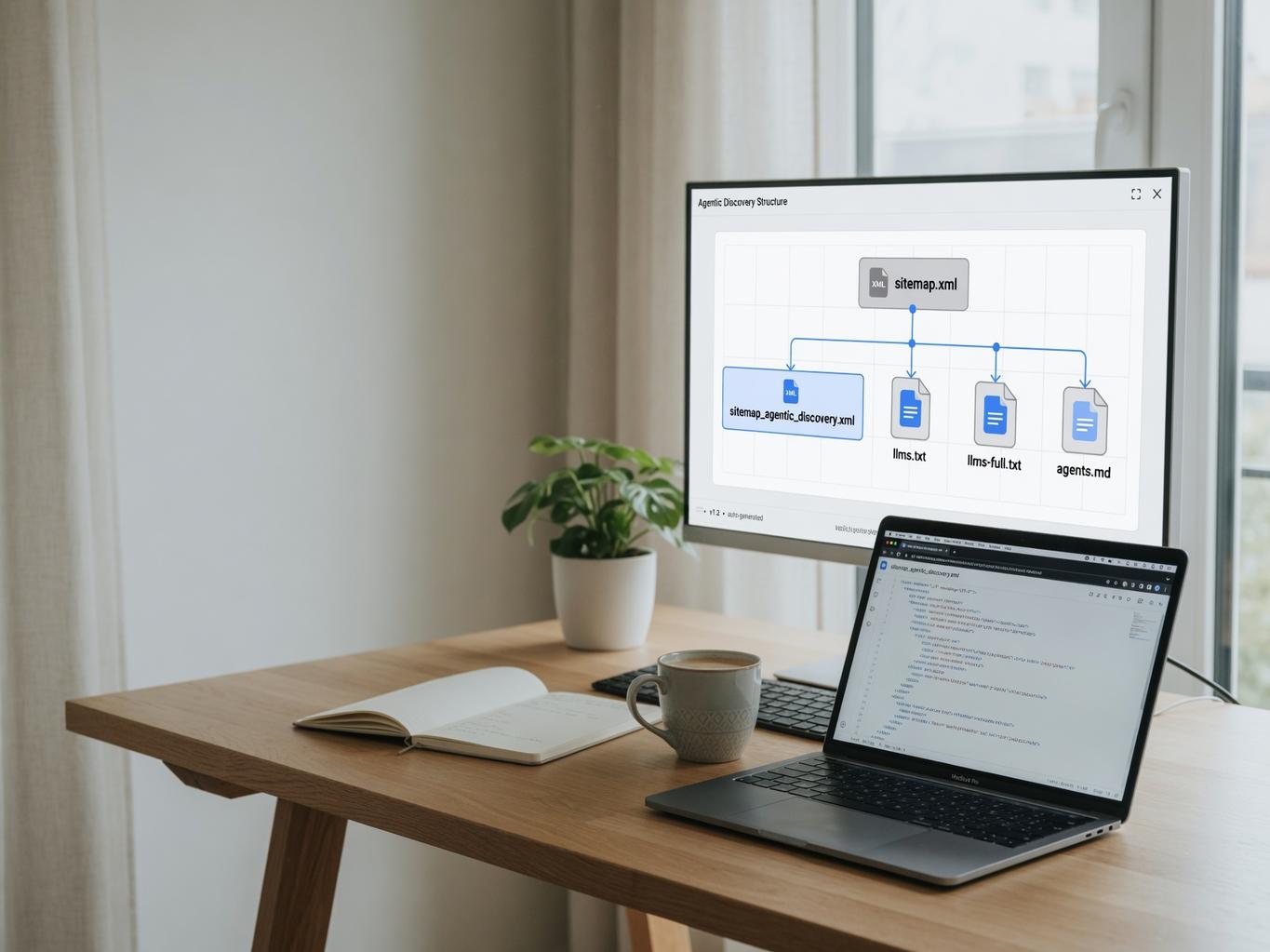
An agentic discovery sitemap is a small, auto-generated XML file, usually found at sitemap_agentic_discovery.xml, that Shopify began shipping to live storefronts in late April and early May 2026. Unlike the standard sitemap.xml that lists every product, collection, and blog post for search engine indexing, an agentic discovery sitemap lists only the handful of files that AI shopping agents need to read first: llms.txt, llms-full.txt, and agents.md. The file lives inside the existing sitemap index, so most merchants never notice it unless they go looking.
This guide checks the claims circulating about the agentic discovery sitemap against Shopify’s own documentation and independent verification reports, and explains what the file actually contains, where it fits in Shopify’s wider AI commerce stack, and what is still unproven.
What Is an Agentic Discovery Sitemap, Exactly?
An agentic discovery sitemap is an XML file, built on the same sitemap.org protocol as a regular sitemap, that points AI crawlers to a store’s agent-facing discovery files instead of its product pages. On Shopify, it sits at /sitemap_agentic_discovery.xml and is referenced from the main /sitemap.xml index, so any crawler that already reads sitemaps can find it automatically.
This matters because AI agents and LLM-based crawlers do not always behave like Googlebot. Many prefer a short, curated summary of a site rather than crawling every page. According to Shopify’s Help Center, every store now serves three discovery URLs: agents.md, described as the canonical source of truth, plus llms.txt and llms-full.txt for crawlers that still look for the older filename convention. By default all three return the same underlying content. The agentic discovery sitemap is simply the index that tells a crawler these three files exist, which is also part of the broader shift some marketers call generative engine optimization, or preparing a site’s data for AI systems rather than only for traditional search engines.
Where the Agentic Discovery Sitemap Fits in Shopify’s Stack
The agentic discovery sitemap is the smallest piece of a much larger system. Shopify built it on top of the Universal Commerce Protocol (UCP), an open standard that Google and Shopify announced together at the National Retail Federation’s NRF 2026 conference on January 11, 2026, with more than 20 endorsing partners including Etsy, Wayfair, Target, and Walmart, according to Google’s own developer blog. UCP defines what a store can do, such as searching its catalog, building a cart, or running checkout, and is reachable at /.well-known/ucp.
The Model Context Protocol (MCP), the open standard Anthropic introduced in November 2024 and donated to the Linux Foundation’s new Agentic AI Foundation in December 2025, is the channel an AI agent actually uses to call those capabilities, exposed on Shopify stores at /api/ucp/mcp. The agents.md file documents how the two work together, including the rule that checkout requires explicit buyer approval before payment is taken. The agentic discovery sitemap does not carry any of that commerce logic itself. It is purely a signpost pointing to the three files that do.
What’s Actually Inside the File
Independent checks of live Shopify storefronts, read alongside Shopify’s own documentation of the underlying files, show the agentic discovery sitemap follows the same urlset format as any XML sitemap, but with only three url entries: one for llms.txt, one for llms-full.txt, and one for agents.md, each marked with a weekly change frequency. It does not list individual products, collections, or blog posts.
That detail matters because some early commentary on the agentic discovery sitemap has implied it directly carries product or collection signals to AI systems. Based on the verified file structure, it does not. Product data still reaches AI agents through Shopify Catalog and the MCP endpoint, not through this sitemap.
Agentic Discovery Sitemap vs. a Traditional XML Sitemap
|
Aspect |
Traditional sitemap.xml |
Agentic discovery sitemap |
| Primary audience | Search engine crawlers such as Googlebot and Bingbot | AI agents and LLM based crawlers |
| Contents | Every product, collection, page, and blog post URL | Three discovery file URLs: llms.txt, llms-full.txt, agents.md |
| Purpose | Indexing for traditional search results | Pointing agents to context and commerce capability files |
| Submission | Submitted manually in Google Search Console | Auto generated, with no separate manual submission documented |
| Editable by merchant | Yes, indirectly through product and page content | No, it mirrors whatever the three source files contain |
Both sitemaps coexist. The agentic discovery sitemap supplements, rather than replaces, the standard one.
A Short Timeline
| Date |
Milestone |
| September 3, 2024 | Jeremy Howard proposes the llms.txt format at Answer.AI |
| November 2024 | Anthropic open sources the Model Context Protocol |
| December 9, 2025 | MCP is donated to the Linux Foundation’s new Agentic AI Foundation |
| December 10, 2025 | Shopify announces Agentic Storefronts at its Winter ’26 Edition |
| January 11, 2026 | Google and Shopify launch the Universal Commerce Protocol at NRF 2026 |
| March 24, 2026 | Agentic Storefronts activate by default for eligible US merchants |
| April 22, 2026 | Shopify migrates its MCP endpoint to /api/ucp/mcp |
| Late April to early May 2026 | Native llms.txt, agents.md, and the agentic discovery sitemap appear on stores |
| June 15, 2026 | The older /api/mcp endpoint is scheduled for removal |
Two separate threads, the open llms.txt and MCP standards on one side and Shopify’s UCP based commerce stack on the other, converged in the same window in spring 2026.
Do AI Crawlers Actually Use the Agentic Discovery Sitemap Yet?
Shopify’s documentation confirms the discovery files exist on every store and that Shopify generates them automatically, without requiring a third party app. Independent crawl log research published by SEO research group WISLR in May 2026 found that mainstream AI crawlers, including GPTBot, ClaudeBot, and Googlebot, had not yet been observed requesting the newer files, specifically llms-full.txt, agents.md, or the agentic discovery sitemap, on a monitored research storefront. Only a Microsoft UCP ingestion bot was observed polling the separate /.well-known/ucp endpoint on its own.
Opinion: critics including Pubcon’s Brett Tabke and writer Kai Spriestersbach have separately argued, in pieces published on Search Engine Land and Medium, that there is no public evidence major AI labs prioritize llms.txt style files over scraped page content when generating answers. Taken together, the infrastructure is live and free to use, but proof that AI crawlers are actively consuming the agentic discovery sitemap at scale is not yet available.
How to Check and Customize Your Store’s Files
To check whether your own store has these files:
- Visit yourstore.com/sitemap_agentic_discovery.xml to confirm the index exists.
- Visit yourstore.com/llms.txt and yourstore.com/agents.md to read the content an AI agent would see.
- Visit yourstore.com/.well-known/ucp to confirm your store’s commerce capabilities are declared.
The agentic discovery sitemap itself is not directly editable, since it mirrors whatever the three underlying files contain. Per Shopify’s Help Center, customization happens at the file level: from Shopify admin, go to Online Store, then Themes, then Edit code, then add a new template named agents.md, llms.txt, or llms-full.txt, and save your edits. Tightening your store’s name and description in Shopify admin also changes the auto-generated content, since those fields feed directly into the files.
Hiding Products From AI Discovery
Merchants who want specific products kept out of AI channels have two documented options. You can opt out of individual AI channels that offer direct checkout, such as ChatGPT, from the sales channel settings. For a fuller removal, Shopify’s documentation confirms that setting a product’s status to Unlisted hides it from AI discovery, but it also removes that product from your sitemap, from Google search results, and from your own on-site search. It is a blunt tool rather than a selective one.
Key Takeaways
- An agentic discovery sitemap is an auto generated XML index, not a product feed. It lists only llms.txt, llms-full.txt, and agents.md.
- Shopify rolled this out natively to every store in late April or early May 2026, with no app or theme change required.
- It sits on top of the Universal Commerce Protocol and Model Context Protocol stack that powers Shopify’s Agentic Storefronts.
- As of mid-2026, there is no public confirmation that major AI crawlers are actively consuming these files at scale, even though the infrastructure is live.
- You cannot edit the sitemap directly, but you can shape its contents by editing your store profile or adding theme template overrides.
Frequently Asked Questions
Is an agentic discovery sitemap a Google ranking factor?
No verifiable data confirms this. Shopify’s documentation does not describe the agentic discovery sitemap as a ranking signal, and no Google Search Central guidance lists it as one as of this writing. Treat it as AI visibility infrastructure rather than a traditional SEO ranking lever.
Do I need to submit the agentic discovery sitemap to Search Console?
No. It is generated and linked automatically inside your main sitemap.xml index. Shopify’s own sitemap submission guidance only asks merchants to submit sitemap.xml itself, not the agentic discovery sitemap separately.
Does blocking AI bots in robots.txt remove me from the agentic discovery sitemap?
No. Per Shopify’s Help Center, robots.txt rules are advisory and only affect open web crawling. They do not stop Shopify Catalog from feeding any agentic storefront channel you have already activated.
Is the agentic discovery sitemap exclusive to Shopify?
The underlying llms.txt and agents.md formats are open standards used across many platforms. The specific filename sitemap_agentic_discovery.xml and its native, no app rollout are, based on available reporting, specific to Shopify’s implementation as of mid-2026.
Will the agentic discovery sitemap replace my regular sitemap?
No. It supplements the standard sitemap.xml rather than replacing it. Both continue to exist side by side and serve different audiences.
Conclusion
An agentic discovery sitemap is a narrow but useful piece of plumbing: a three line index that tells AI agents exactly where to find a store’s llms.txt, llms-full.txt, and agents.md files. Shopify’s native rollout removes the setup work merchants used to pay for, but it does not guarantee that AI crawlers are reading those files yet. Until clearer adoption data exists, the practical move is to confirm the files exist on your store, keep your store profile accurate, and treat the agentic discovery sitemap as infrastructure rather than a ranking lever.
Artzen is a performance-driven agency specializing in ecommerce SEO services in India. Backed by years of industry experience and a team of certified, highly skilled SEO specialists, we implement strategies with precision and measurable growth. We prioritize our clients at every stage, delivering results that exceed customer expectations.