“In 2026, the blue link era of Google is officially in the rearview mirror. With the global rollout of AI Overviews, Shopify AEO optimization has become the new competitive edge for merchants who want to move beyond just ranking #1 to actually becoming the source. If you want your products recommended by Google’s Gemini-powered search, traditional SEO alone isn’t enough – you need to master Answer Engine Optimization.”
Need an expert to navigate this shift? Artzen Technologies specializes in cutting-edge Shopify development and AI-driven SEO strategies to ensure your store doesn’t just rank, but dominates the AI-first search landscape.
This guide will break down the fundamental differences between AEO and SEO and provide a step-by-step roadmap to optimizing your Shopify store for the AI-first world.
1.SEO vs. AEO: Why Shopify AEO Optimization Changes Everything
To optimize effectively, you must understand the two forces at play.
- Traditional SEO (Search Engine Optimization): Focuses on ranking a URL in a list of results. The goal is to drive clicks to your website. Success is measured by keyword rankings and organic sessions.
- AEO (Answer Engine Optimization): Focuses on providing the direct answer that an AI model uses to generate its overview. The goal is to be the cited source. Success is measured by “brand citations,” “mention velocity,” and appearing in the AI snapshot.
Why Shopify Stores Need Both
While SEO gets people to your “Best Coffee Roasters” blog post, AEO ensures that when a user asks, “What is the best light roast for an AeroPress?”, Google’s AI pulls your specific product recommendation and links directly to your checkout.
| Feature | SEO (Traditional) | AEO (AI-Driven) |
| Primary Goal | Traffic & Clicks | Authority & Citations |
| Content Format | Long-form, Keyword-rich | Concise, “Atomic” Answers |
| Success Metric | SERP Position (1-10) | Inclusion in AI Overview |
| User Intent | Browsing/Researching | Problem-solving/Quick Answers |
2. The “Atomic Answer” Framework
Google’s AI doesn’t want to read a 2,000-word essay to find a price or a feature. It looks for Atomic Answers—concise, factual blocks of text that are easy to digest.
How to Implement This on Shopify:
- The 50-Word Rule: For every major heading (H2) on your product or blog pages, provide a direct answer in 40–60 words immediately below it.
- Question-Based Headings: Instead of a heading like “Shipping Policy,” use “How long does shipping take for [Product Name]?”
- The “Island Test”: Ensure every paragraph can stand alone and make sense without the rest of the page. This makes it easier for AI to “clip” your content.
3. Shopify Product Page Optimization for AI Overviews
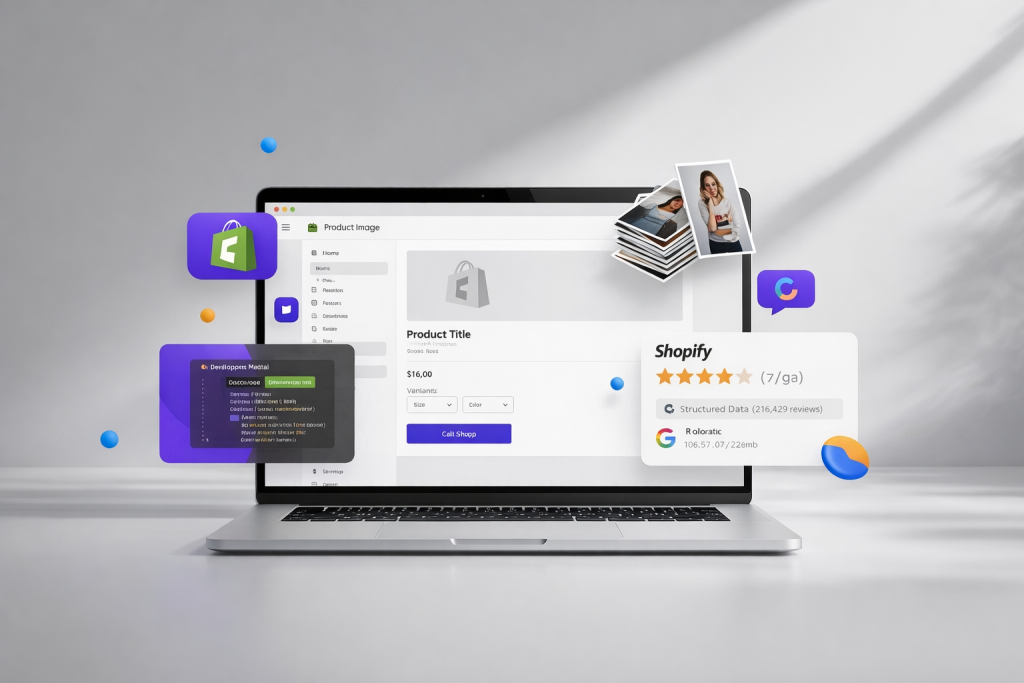
Product pages are the heart of your store, and getting them right is the core of any serious Shopify AEO optimization strategy. To get them into AI Overviews, you need to go beyond standard descriptions.
A. Semantic Depth over Keywords
In 2026, Google uses Vector Embeddings to understand how products relate to each other. Don’t just repeat “waterproof hiking boots.” Mention “Gore-Tex membrane,” “Vibram soles,” and “moisture-wicking liners.” Covering the “semantic neighborhood” tells the AI you are an expert source.
B. Use Multi-Modal Content
Data shows that pages with Text + Image + Video + Schema have a 317% higher selection rate for AI Overviews.
- Images: Use original, high-res photos (WebP format) with descriptive Alt Text.
- Video: Embed 60-second “explainer” videos showing the product in use.
- Tables: AI loves structured data. Include a “Specifications Table” comparing different models or sizes.
4. Technical AEO: Schema is Your Secret Weapon
If SEO is the skin of your site, Schema Markup is the skeleton. It tells the AI exactly what it’s looking at.
For Shopify, ensure you have the following JSON-LD schemas implemented (using an app or custom liquid code):
- Product Schema: Must include price, availability, SKU, and aggregateRating.
- FAQ Schema: Essential for AEO. This turns your product questions into “read-aloud” answers for AI.
- HowTo Schema: Perfect for “How to use” or “How to style” sections.
- Review Schema: High-star ratings from verified buyers are a massive trust signal for AI.
5. Building E-E-A-T for AI Trust
Google’s AI is programmed to avoid “hallucinations” by citing only trustworthy sources. This is where E-E-A-T (Experience, Expertise, Authoritativeness, Trustworthiness) comes in.
- Author Bylines: Don’t post blogs as “Admin.” Use a real person’s name with a bio linking to their LinkedIn or professional credentials.
- Information Gain: Don’t just rewrite what’s already on the web. Include unique data, proprietary customer surveys, or first-hand “tests” of your products.
- Citation Velocity: AI looks at how often your brand is mentioned across the web. Encourage mentions on Reddit, niche forums, and high-authority publications to build your “brand moat.”
6. The 2026 Shopify AEO Optimization Checklist
To ensure your store is ready for the next wave of AI search, follow this monthly audit:
- [Audit for “Zero-Click” Queries]: Identify which of your keywords now trigger an AI Overview.
- [Update Top 10 Pages] : Add “Atomic Answer” summaries (50 words) under every H2.
- [Check Mobile Core Web Vitals] : AI Overviews take up screen real estate; your site must load in under 2 seconds to retain the users who do click.
- [Implement llms.txt] : Create a text file in your root directory (similar to robots.txt) specifically for AI crawlers to help them understand your site’s hierarchy.
- [Refresh Old Content] : AI prefers “fresh” data. Update your guides and product descriptions every 90 days to maintain “Citation Velocity.”
Conclusion: Adapt or Disappear
The shift from SEO to AEO isn’t about choosing one over the other; it’s about evolution. Traditional SEO brings the volume, but AEO captures the high-intent “ready to buy” customers who are using AI to make decisions.
By treating Shopify AEO optimization as an ongoing process – built around Atomic Answers, Deep Schema, and E-E-A-T – you won’t just rank, you’ll become the definitive answer Google serves your customers.
Artzen is a performance-driven agency specializing in ecommerce SEO services in India. Backed by years of industry experience and a team of certified, highly skilled SEO specialists, we implement strategies with precision and measurable growth. We prioritize our clients at every stage, delivering results that exceed customer expectations.